Chester Barnard is one of the men who most influenced management in the 20th century. Unknown in France, the man who is also at the origin of CSR nevertheless formulated particularly important ideas about team motivation and the notion of efficiency.
Recently, faced with how hard companies find it to recruit and to pass on a sense of commitment to their new hires, we thought we would look to the economic literature to meet this challenge. So we asked Google what percentage of people are satisfied with their job.
According to surveys, 77% of French people say they are satisfied with their job, but digging deeper, only 45% of French people would recommend their company to friends and family as a place to work, and only 8% are happy to go to work every morning. (Sources: Europe 1, HR Voice and IFOP)
1. Motivating employees after an economic crisis
On the other side of the Atlantic, while Americans envy French working conditions, their statistics are impressive. With dismissal possible within 15 days and no entitlement to unemployment benefit, only 10 days of paid leave and a 40-hour working week, they are in theory the most likely to complain.
Yet a 2023 survey reveals that 20% are passionate about their profession and 49% say they are very satisfied with their job. In total, 65% of Americans are very happy with their professional situation (source: Zippia)
To explain such a gap in perceptions, we need to mention a book that marked and influenced human resources management in the United States from the early 20th century: The Functions of the Executive, written by Chester Barnard.
The concepts in The Functions of the Executive were regarded by Kenneth Richmond Andrews (the economist behind the notion of corporate strategy) as the most interesting on management ever published by a business leader. This famous book was written by Barnard, a former Harvard economics student who, at 41, was appointed President of a huge American company: American Telephone & Telegraph, better known today as AT&T.
"The Functions of the Executive" was published at a key moment in history: just after the enormous financial crisis of 1929. As a reminder, in the early 1920s, modest American workers who believed in the dream of making a fortune were given the chance to invest in the stock market. For these small savers, the opportunity turned into a nightmare. Dishonest traders took advantage of these American workers' ignorance to get rich at their expense, plunging the country into the biggest financial crisis it had ever known. Top executives were informed of the imminent economic risk but looked away and did nothing to prevent the chain reaction.
When the financial earthquake hit the continent, plunging its workers into poverty, America needed to re-motivate its workforce. Employees no longer saw their leader as a boss acting like a good father figure, but as the person responsible for their misery. For 10 years, Barnard therefore observed, tested and wrote down the mechanisms that allowed him to re-motivate his teams.
In 1938 his book was finally published, sometimes criticised, often acclaimed. Here is a brief summary of a work that has unfortunately never been translated into French.
2. Letting your teams take part in building the company
- The first idea describes the theory of cooperation within an organisation
- The second idea, the role of decision-makers in that organisation
In his observations, Barnard notes the importance of interactions between the different groups in a firm: how the various departments communicate, how customers behave towards sales staff, subcontractors towards technical teams, and so on.
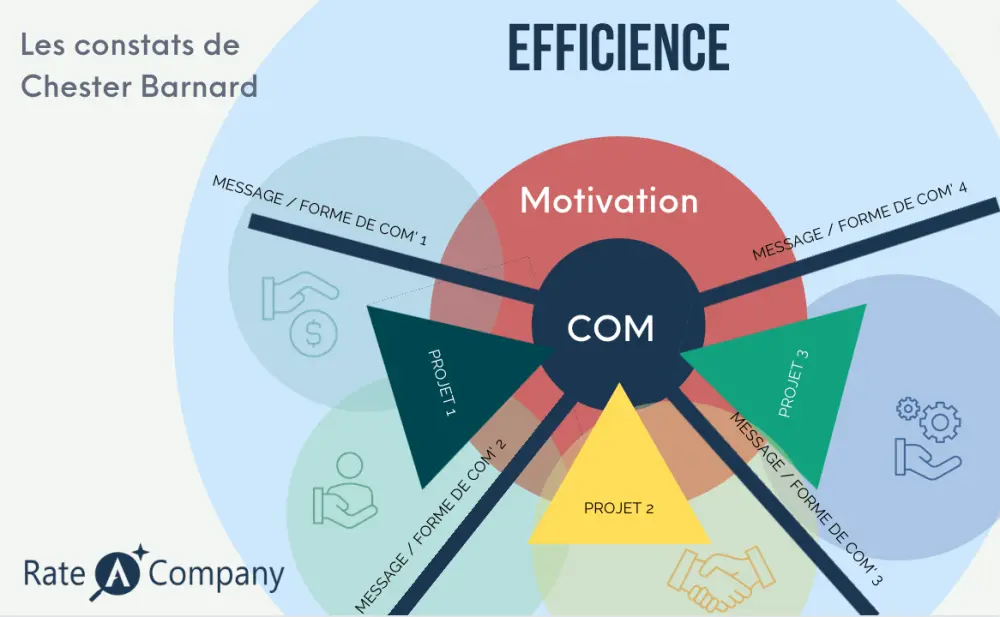
He is therefore the first to raise the importance of stakeholders in the notion of efficiency. According to him, for a corporation to optimise the way it operates and be successful, it needs:
· Management to communicate transparently and in a way suited to each stakeholder: explaining the company's priorities and values, presenting the major projects ahead, and so on.
· Stakeholders, and employees in particular, to buy into the values and upcoming projects championed by the leader
· Projects to be clear, properly defined and to support the shared interests of all stakeholders.
He is the first to raise the importance of identifying small shared objectives for the different people involved in the company and of constantly setting new projects with a view to continuous improvement, a principle that a CSR label should encourage and take into account. For example, letting sales staff work with technicians to create a new product, or letting employees work with human resources to organise an event, and so on.
He notes that these small projects, intended to energise the company's activities, must respect 4 elements:
· the employee, or the stakeholder, understands where the leader wants to take the company; the messages conveyed by management are clear in substance and in form
· this communication, or these small projects, at the time they are formulated, are not perceived as going against the company's interests
· these projects do not go against employees' personal interests: for example, if the company's goal is to reduce its carbon emissions and it asks its employees to travel only by bike from tomorrow, how does the company implement this without the employee feeling they are losing quality of life?
· the stakeholder concerned by the decision is mentally and physically able to carry it out: if employees are asked to work on new personal projects, they must not feel oppressed, judged or incapable.
3. Setting up rewards to motivate employees
In this book, Barnard reminds us that the leader's most important role is to communicate objectives properly so that employees are proactive. For them to take part in the organisation's success, incentives must be put in place. Curiously, the word "incentives" has no equivalent in French: it means both "rewards" and "forms of motivation".
Incentives can take different forms depending on individual expectations. They may be material (salary, company car, meal vouchers) and/or "moral benefits", ideal benefactions: congratulations, thanks, encouragement, promotions, belonging to a community, and so on.
For him, these elements are essential for employees to respect the leader and take a full part in the company's success. It is a give-and-take that is not limited to salary but gives the employee the chance to feel proud (values), empowered (skills development) and engaged within a community (the company).
The "zone of indifference" in employee motivation
Barnard notes that individuals have a zone within which they are able to accept a decision without questioning it. The extent of this zone of indifference depends on the benefits we perceive in relation to the effort required: benefits may take the form of recognition of social status, salary or pay, but also of contribution to society and the gratification that contribution brings.
In short, the idea is that the more a person feels they are benefiting from the company (materially or morally), the more inclined they will be to accept decisions without questioning them. Conversely, the less that person feels they are benefiting, while making efforts every day, the more they will challenge leaders' decisions. A company's commitment on the social side and its contribution to the fight against the various forms of pollution can re-motivate employees. But this intention must be clearly expressed by the leader and backed by concrete human and financial resources to support the vision.
Barnard also notes that the less individuals are consulted and included in the company's activities and goals, the narrower the zone of indifference will be, and the quicker they will be to question decisions.
4. Guaranteeing good governance to strengthen the authority of the position
The economist notes that people will respect a decision according to the managerial rank of the person issuing it, but also according to that person's natural leadership. The higher the decision-maker's hierarchical role and the greater their natural ability to unite people, the less inclined individuals will be to question the order. To put every chance on their side, the decision-maker must ensure both for each of their managers. Leadership is earned through competence (which builds trust), the values embodied by that person and "soft skills".
The leader must therefore take these aspects into account in their governance and encourage diversity to boost performance.
Finally, in his last chapter, "The Nature of Executive Responsibility", Barnard notes that cooperation must be the source of the creative process that will bring new projects to the organisation. These new projects must not be the decision of the executive alone. Managers and the executive will be responsible for coordinating cooperation between stakeholders in the interest of the company and of each stakeholder. He also notes that the leader's moral quality is essential to the company's success. The more leaders demonstrate morality, the more stakeholders will be able to support the strategy through hard times and contribute to success.
Today, in CSR, behaviour change is the hardest thing to bring about in a company. If management, pushed by regulation, wants to put in place sustainable measures approved by its stakeholders, Rate A Company has a range of solutions to guarantee the success of this approach.
The Functions of the Executive is regarded by economists across the Atlantic as one of the most revolutionary works on management. It paved the way for team leadership in American companies. It was reissued in 1968, at another key moment in US history. During that period, dialogue between conservative leaders and American youth broke down, once again calling into question the sustainability of business.
Did you know? Chester Barnard is also the man who commissioned the first recognised work on CSR, Howard Bowen's Social Responsibilities of the Businessman, a book that laid the groundwork for the notion of sustainable development within companies for the years to come.
Did you know? Barnard is regarded as a leading figure in management and stands apart from certain other economists notably through his very personal redefinition of the term efficiency, which refers to the capacity to produce. For him, production is directly correlated with the motivation of individuals: the famous stakeholders.
Did you know? Vocabulary is particularly important in a country's culture. Besides the lack of a French translation for "incentives", there is also no French equivalent for the term "empowerment": giving someone back their confidence, and the power temporarily entrusted to them.