
Forgot your password?
Request a reset code
Enter your email address below and we'll send you instructions on how to reset it.

Rate A Company uses cookies and certain technologies to analyse the browsing habits of visitors to our site, helping to build a fair and transparent future. You can accept or refuse these cookies: your choice is kept for 6 months and you can change it at any time via the “Manage my cookies” link at the bottom of the page.
The Stakeholder Rating is an organisation’s CSR score, calculated from the assessments of its own stakeholders — customers, employees, suppliers, investors, candidates, associations — against 80+ CSR criteria, with Rate A Company, as an independent third party, verifying their authenticity. With additional guarantees, this score can also be awarded the official CSR Label – Stakeholder Rating, recognised by the French State.
The first CSR label registered as a guarantee mark with the INPI
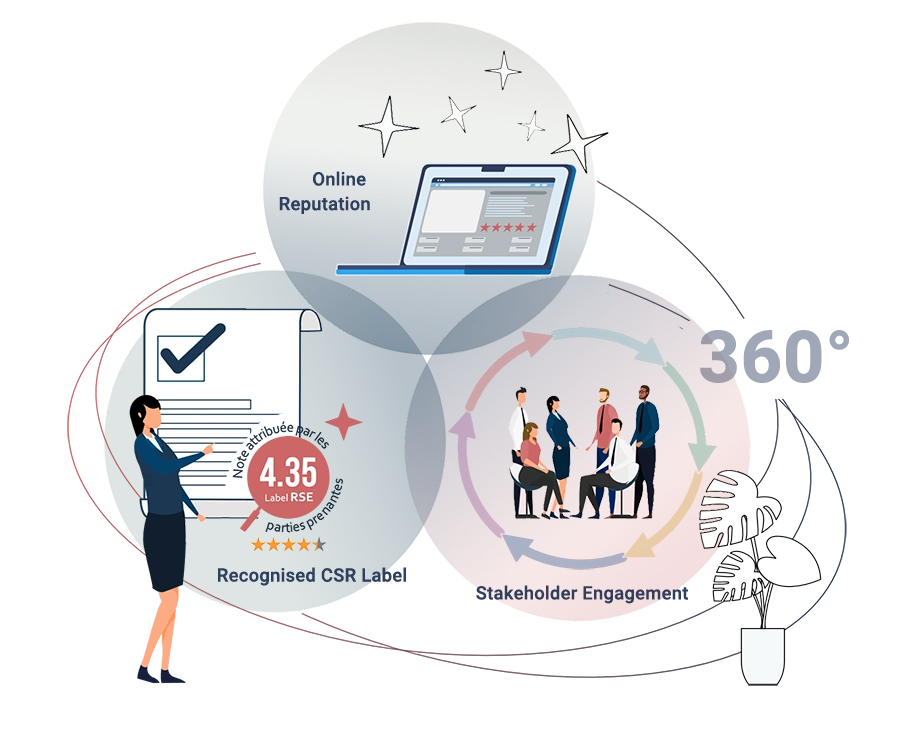
Show how your CSR commitments translate into everyday practice. The CSR Label – Stakeholder Rating brings together feedback from the people who know your organisation: your customers, employees, partners, suppliers and other stakeholders.
Our structured assessment helps you understand your environmental, social and business practices, identify priorities and communicate your results through a clear stakeholder rating.
Building on our experience of stakeholder-based CSR assessment since 2015, we developed our labelling methodology over two years and, in 2022, registered the first CSR label recognised as a guarantee mark by the INPI, France's national industrial property office.
How our CSR label works
The CSR Label – Stakeholder Rating is awarded following a Rate A Company CSR audit. The audit invites all your stakeholder groups to assess 80+ CSR criteria, with questions matched to their experience of your organisation.
Participants can include customers, employees, partners, investors, service providers, suppliers and other relevant stakeholders. Their ratings and comments provide a picture of how your practices are experienced across your business ecosystem.
The results help you recognise strengths, investigate concerns and choose practical improvements. They also provide stakeholder insights that can inform your sustainability reporting, including your work under the Corporate Sustainability Reporting Directive (CSRD). The CSRD and its 12 ESRS standards set out the reporting obligations: 5 cover the environment, 5 cover social matters and business practices, while the first 2 set the framework. Measuring sustainability indicators and consulting stakeholders is exactly what our digital labelling tool does.
Clear, transparent assessment criteria
Our framework includes 80+ criteria drawn from ISO 26000, ISO 20400 on sustainable procurement, the United Nations Sustainable Development Goals (SDGs) and the European Sustainability Reporting Standards (ESRS) under the CSRD.
The framework is publicly available online. Questions are written in plain language so stakeholders can contribute without specialist CSR knowledge. The assessment covers three broad areas:
By inviting stakeholders to assess the practices they experience, you give them a practical role in your CSR approach. Their feedback helps you understand what matters to them and where change would make a difference.
If you choose to publish your results, this feedback also gives prospective customers, employees and partners a clearer picture of your organisation.
How is the label score calculated?
The score displayed on your label is the weighted average of the ratings submitted by your stakeholders. The assessment follows a structured process:
The label combines stakeholder ratings with a structured CSR assessment. It provides an accessible way to communicate your results while retaining detailed indicators to guide your next steps.
Did you know? A lower score can still provide valuable insights. You can choose not to display your label and use the audit findings as a baseline for improvement. A follow-up audit then helps you assess progress after implementing your action plan.
Tailored questions to guide your CSR strategy
In addition to the framework's 80+ CSR criteria, you can include questions tailored to your sector, organisation and priorities. These questions collect qualitative feedback to help you explore specific issues, compare improvement options and understand which actions stakeholders consider most useful.
Additional questions do not contribute to the final label score. They help you refine your strategy and understand how stakeholders can contribute to its implementation.
Your CSR team can develop these questions. Rate A Company can also support you through tailored guidance and training, helping you design a consultation that reflects your organisation's needs.
Our aim is to make stakeholder assessment practical and affordable, leaving more resources available for implementing improvements.
Did you know? Rate A Company is Qualiopi-certified, the French quality certification for training providers. Depending on your eligibility and the applicable funding arrangements, financial support may be available through your OPCO, the sector body that supports vocational training in France.
Explore our CSR training courses
How the CSR Label – Stakeholder Rating began
We launched Rate A Company in 2015 to make stakeholder consultation a practical part of CSR assessment. Drawing on our international CSR experience and technical and academic knowledge, we developed a digital platform inspired by online rating tools. It enables customers, employees, partners, suppliers and civil society to share their experiences of an organisation's CSR practices. From 2016, the platform has also supported the collection of concerns relevant to whistleblowing processes under France's Sapin II Act.
In 2019, organisations with positive stakeholder ratings asked for a label they could display in their communications. We began developing the labelling methodology and reviewing the relevant recommendations and registration requirements. This work led, in 2022, to the registration of the first CSR label recognised as a guarantee mark by the INPI.
Transparency remains central to our approach. Our assessment framework is publicly available, and our rules of use explain the conditions under which the label is awarded and used.
Hundreds of stakeholders, not one or two assessors: the rating is a collective verdict, free from the bias of a single viewpoint, and Rate A Company independently verifies the authenticity of every contribution. When audit results are published, stakeholders who participated can check their contributions. This connection between the label and the underlying feedback helps organisations explain their CSR performance with greater credibility.
Find all the characteristics of a trustworthy label in our article or in our video
Use stakeholder insights to inform your sustainability reporting
Stakeholder consultation helps you understand your organisation's impacts and the sustainability issues that may affect its performance. These insights can feed your double materiality assessment and point to matters worth investigating further across your value chain.
Our methodology gives you a structured way to collect this feedback. Combine the results with your other evidence, data and analysis to strengthen your sustainability reporting. For a fuller explanation of double materiality and the value chain, visit our stakeholder-based CSR audit page.
Scores are reported to two decimal places, allowing you to compare results between audits. Reviewing changes alongside participation levels and qualitative feedback helps you understand where stakeholder experiences have improved and where further action may be needed.
Understand the label's registration and rules of use
When choosing a CSR label, it is useful to understand who operates it, how performance is assessed and what conditions govern its use. Since 2019, French regulations have required labelling organisations to file their rules of use officially: the mark that awards a label becomes responsible for it and must comply with the provisions set out in that document. Clear criteria and accessible rules make it easier to judge what a label represents and how its claims are supported.
To find out whether a label is official in France, you can type its name into the website data.inpi.fr. If the label is registered as a guarantee mark or collective mark, it is an official label. If, however, it is registered as a word mark, figurative mark or semi-figurative mark, it is a brand, just like Nike or Coca-Cola, and does not meet the current French regulations on labelling.
The CSR Label – Stakeholder Rating is registered as a guarantee mark with the INPI and operated by Rate A Company. Its rules of use set out the conditions for awarding and using the label, providing a reference for organisations and their stakeholders. You can consult the registration through the INPI database to check the status of the mark and the framework behind the label.
Did you know? There is currently no official European CSR label. Our transparent methodology, guaranteed in France, offers organisations a label that everyone can understand, in France and internationally.
Consult our rules of use
Choose whether to publish your audit results
With our Self-managed CSR audit or our CSR Audit & Strategy Programme +, you decide whether to publish your stakeholder ratings and comments or keep them private. If your results support the CSR commitments you want to communicate, publishing stakeholder feedback can help customers, employees and partners understand your practices. You can also use the findings privately to guide improvements before deciding whether to share them.
Organisations that publish their audit results on our platform receive a pink “Verified audit” badge, displayed at the top left of their logo on their company page.
Frequently asked questions about the Stakeholder Rating
It is a CSR score out of 5 that is not given by an assessor but by all of an organisation's stakeholders: its customers, employees, suppliers and service providers, investors and partners, candidates, and the associations and media that know it. Each of them rates the practices they actually experience, against precise CSR criteria. The score is therefore a collective verdict, not the view of one or two people.
An organisation's six stakeholder profiles: customers and taxpayers; employees and interns; investors and partners; suppliers, contractors and service providers; candidates and sales representatives; associations, media and all others. Each profile answers the questions that match its experience of the organisation: an employee is not asked about supplier payment terms, and vice versa.
The framework includes 80+ CSR criteria drawn from ISO 26000, ISO 20400 on sustainable procurement, the United Nations Sustainable Development Goals and the ESRS standards under the CSRD. Each criterion is rated from 1 to 5 stars. The ratings of all stakeholders are then aggregated to produce the overall score, reported to two decimal places, together with detailed indicators by theme. The method is described in the section "How is the label score calculated?" on this page.
One of the advantages of online tools is that responses are much more traceable than on paper. We have implemented a range of checks to help prevent fake reviews, particularly multiple reviews originating from unexpected geographical locations. However, as with any online review platform, we cannot be 100% certain of each reviewer’s identity or whether they are qualified to provide a relevant assessment. This is one of the differences between the open online rating and the CSR Label, for which we can verify every reviewer’s profile.
On the platform, anyone can rate an organisation's CSR impact free of charge: these spontaneous reviews are moderated, but Rate A Company cannot guarantee that they cover all stakeholder groups, nor verify every contributor individually. The CSR Label – Stakeholder Rating is based on the audit formula instead: the organisation invites all of its stakeholders, Rate A Company verifies their identity and the authenticity of their ratings and comments, and it is this verified score that appears on the label. Only the audit formula therefore makes it possible to guarantee both the stakeholders and their reviews.
A conventional audit or certification relies on the judgement of one or two auditors, based on documents and interviews selected by the organisation. The Stakeholder Rating relies on dozens, sometimes hundreds, of people who experience the organisation's practices every day. It is therefore less exposed to the bias of a single viewpoint and reflects the real experience of the organisation's ecosystem. The two approaches are complementary: stakeholder consultation feeds, for instance, the double materiality assessment required by the CSRD.
Yes. Since 2022 it has been registered with the INPI, France's industrial property office, as a guarantee mark – the status French regulations have reserved for labels since 2019: the body awarding the label is responsible for it and must comply with filed rules of use. It is the first CSR label to hold this status. You can check the registration on data.inpi.fr and consult our rules of use on this page.
Directive (EU) 2024/825 requires sustainability labels used in commercial communications to be based on a certification scheme verified by an independent third party or established by a public authority. The CSR Label – Stakeholder Rating is awarded by Rate A Company, a third party independent of the organisation being assessed, which verifies the authenticity of the ratings, under public rules of use and a framework available online. The criteria and the method can be consulted by anyone.
The label is awarded following a Rate A Company CSR audit, through either the Self-managed CSR Audit or the CSR Audit & Strategy Programme +. In the Self-managed CSR Audit, the second, strategic part of the audit—which is not included in the label’s overall score—is prepared entirely by the company and submitted to Rate A Company.
In both cases, the organisation invites its stakeholders to assess it against the framework, receives its detailed results, and then decides whether to publish its score and label. Organisations that publish their results on the platform receive the “Verified audit” badge, the pink stamp, on their company page.
Yes. A lower score than hoped for is still valuable information: the organisation can keep its results private, use them as the starting point of its action plan, then run a follow-up audit to measure progress. As scores are reported to two decimal places, changes from one audit to the next are easy to track.