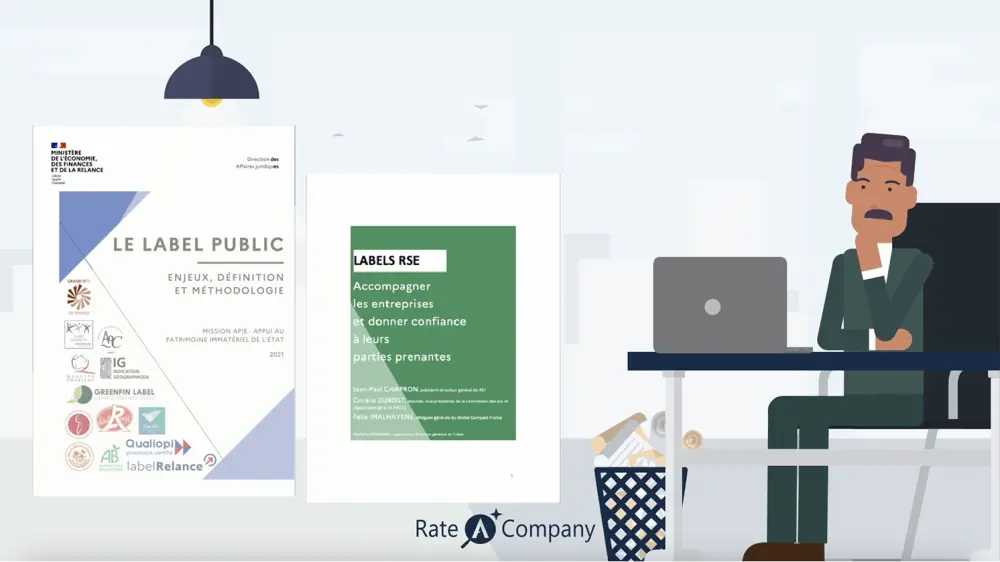
This article is based on two recent reports submitted to the Ministry of Economy, Finance and Recovery in France which reports on the situation of labels and certifications at a time when consumers are looking for transparency on what they buy. You can also find this topic on our Youtube channel!
Next, let us introduce you to the report "CSR Labels: supporting companies and giving confidence to their stakeholders" that we will call REPORT A.
It was submitted November 30, 2020 to Bruno Lemaire, Minister of Economy, Finance and Recovery to follow up on the PACTE law that wants to encourage companies, even small ones, to consider CSR in their activities.
Faced with leaders who drag their feet, the French government is seeking to assess the relevance of labels that promote products, structures or strategies that set an example.
In this A report, we learn that 90% of SMEs have CSR initiatives, i.e. tens of thousands of companies, but that only a few hundred SMEs have been awarded a label or certification. It is written that "many companies do CSR without knowing it. If the benefits remain the same for their employees and their companies, the problem is that they do not value their efforts enough and cannot benefit from it for their development".
What the report refers to is what more and more consumers realize when they purchase: cheap clothing is often synonymous with sometimes very young women workers in Bangladesh bent over 12 hours a day over their sewing machines. All this, only so that the fabric starts pilling after the second wash and ends up in the garbage a few weeks later.
Is the pleasure of wearing this garment worth the impact it has on our planet? The new generations who have access to videos on Youtube, Tik Tok and other social networks seem to say no.
The report is aware of the economic stakes and the risk of greenwashing or socialwashing: this principle which consists of spending big marketing budgets to persuade the public that it is a committed company, when it could have put these pennies in a really impactful initiative.
See our topic on marketing and CSR
The CSR labels and certifications, which are supposed to provide a minimum guarantee against this greenwashing phenomenon, do not seem to convince anyone today. The report writes "In the face of this craze for CSR, the lack of success of these labels and certifications raises questions".
The problem with CSR is that there are as many solutions as there are companies.
Measuring the same scientific criteria on social, environmental and economic performances for all companies remains an illusion. A person working in the heart of Paris will not have the same expectations in terms of well-being at work as someone working in a sawmill in Ardèche.
In the same way, the evaluator of the agency awarding the CSR label will probably say to a boss "to anticipate the demands of the regulations, invest in logistics that will generate fewer return orders, and therefore less CO2". However, this boss will ask himself twice: his employees are not really productive anymore because they question the amount of work and any change that would disturb their habits. For this executive, this new investment may finally sound the death knell for his employees’ appreciation of him : how would management decide to invest in machines rather than people?
In the notion of CSR labeling, there is therefore the idea of trusting someone from outside to evaluate the situation and improve the company performance. But for an SME owner who has set up the business, it has proven to be difficult to pay for this uncertain step, however important it may be.
The A report notes the lack of methodology and the proliferation of less sincere and qualitative CSR labels and certification and asks the question "Under what conditions do CSR labels constitute vectors of mobilization in favor of CSR for the company and its stakeholders?”
The report A reminds us that in terms of CSR, a company must go BEYOND its regulatory obligations and individual prosperity. Obtaining a CSR label therefore depends on the efforts the company previously had to make in order to comply with the regulatory framework.
As we have seen in our article on CSR regulations, the law also depends on the size of the company: companies with a turnover of more than 100 million euros or 500 employees must publish an extra-financial report which forces them to a minimum of transparency. Companies with more than 5,000 employees in France and 10,000 employees worldwide must implement a methodology that allows them to monitor that the practices of their suppliers and subcontractors are in compliance with local regulations and human rights.
The parliamentary report recalls that the 2019 PACTE law changed the regulatory definition of a company's "social interest" by saying that it was not a matter of satisfying the expectations of shareholders alone but of all stakeholders.
This report also lists all the labels that the French government has launched in recent years to encourage more ethical behavior: the famous Greenfin and SRI financial labels, the RFAR responsible purchasing label, the gender diversity label, etc.
It would therefore be difficult for the rapporteurs to completely denigrate the usefulness of these labels.
On the other hand, it is necessary to mention the situation: "The multiple offer lacks legibility".
And yet, if the universities and Grandes Écoles now integrate these notions into business, marketing, engineering and other curricula, let's be honest: 60% of managers have already heard the term CSR but less than 2% admit that they had a precise idea of what it represented following the training*.
Report A identifies a problem that will be taken up again in Report B, entitled "The Public Label, Issues, Definition and Methodology". "The absence of a framework for labels has allowed the development of a significant offer”. This is the least that can be said. Today in France, there are about 400 labels that certify on different criteria, each with its own specifications and more or less serious methodology.
In terms of CSR, in the sense of the company's operations, there are about forty of them. In France. So what about at the European level?
Why so many labels?
To answer this question, we must look at the report B.
The international ISO 26,000 reference on the subject has proved unable to deliver a certification: as we saw earlier, there are as many CSR approaches as there are companies operating in an environment, so it is impossible to impose common rules for all of them, as can be done with industrial objects: to have the certification / fireproof standard, you need to use such and such a material, in such and such a thickness, etc.
In the framework of ISO 26000, it is rather a question of recommendations with an approach to constant evolution dependent on innovations and societal expectations: the experts who deliver the ISO 26000 label say "according to our observations, it is recommended you do this ".
Strictly speaking, there is no CSR CERTIFICATION in the international sense. Hence the multitude of labels which are subject to far fewer constraints and/or which constraints are much harder to identify.
Indeed, the B report states that for a long time, labels, including those of the State and public authorities, were simply trademarks registered with the INPI. There was not even a need to attach specifications that defined the scope and methodology of the label.
Seventy years ago, labels did not represent as much economic interest and those who received the label did so more out of conviction than for the sake of profit. There was no need for safeguards. A company or an authority could register a name and start selling the label to like-minded bosses.
However, with the appearance of the organic label in the 1960s, positive repercussions in terms of sales were quickly felt. The AOC label, Appellation d'Origine Contrôlée, was a huge commercial success and attracted all sorts of profiles eager to exploit this economic opportunity.
The spiral of labels for commercial purposes is underway. Gradually, the awarding of a label without real specifications also suits an unscrupulous boss who will find it less restrictive to sign a check than to completely review his way of working.
Without going as far as bad faith, the proliferation of labels also came about because some manufacturers wanted to obtain a reward, a label, for the angle that was dear to their hearts, the particular thing they were doing well.
These "convenient" labels and the proliferation of labels as brands launched by local authorities such as Grand site de France, Région de Bretagne etc. have contributed to the confusion and therefore to the progressive disinterest of citizens and professionals.
As a result, most managers prefer to keep their money and their time rather than to hurt their company's image and attach it to a label that could potentially be accused of Greenwashing or Socialwashing. This is the precautionary principle in basic reputation management.
This explains the opacity of the methodology used by some labels: is it a self-evaluation, an on-site evaluation by a consultant? Which structure has been awarded the label: a subsidiary ? the head office?
Report A highlights another important obstacle in this label approach: "the absence of publication or the difficulty of accessing the evaluation criteria or questionnaires online".
Finally, in an interconnected world where business crosses borders, the report raises the question of the value of a CSR label internationally. This question is all the more reasonable if these foreigners do not have access to the methodology or the evaluation criteria.
Finally, the A report highlights the lack of incentives on the part of public systems to reward and encourage companies to take this step. Because the label, if correctly understood, remains the best way to judge the quality of an organization's approach. To encourage companies to take the CSR labeling step, more and more public services are adding sustainable criteria to their calls for tender.
In order to know if your organization should be awarded the label, you must ensure that
- That the label offers guarantees: this rules out labels and certifications that rely on self-assessment since the criteria must be judged by one or more people who are not directly impacted by the company's economic performance: a trusted third party independent of stakeholders and interest groups is therefore required.
- The methodology used must be transparent: who audits, for how long, where, with whom. If the auditor only talks to 2 employees out of 90, what is the value of the audit?
- The criteria must be transparent and/or the results must be made public: what was scored, what formula was used?
- The criteria must be relevant: if the criterion judges "mistreatment in the workplace", it will not have the same value as "your management promotes well-being in the workplace", first of all, because the first criterion is a regulatory one (respect for human rights, punishable in the event of non-compliance) whereas the second evaluates a CSR criterion
- The evaluation criteria must be clearly understood by all: some labels and certifications, particularly in the area of responsible finance, are so convoluted that if the criteria are made public, they will not be understood or will be misinterpreted by the investor concerned.
- The criteria must be consistent with "internationally recognized standards while awaiting the development of a European reference framework". The advantage of the ISO and its 7 themes is that it is compatible with the 17 SDGs, the UN Sustainable Development Goals
- The A report emphasizes that the company must communicate openly about its labeling or certification, especially to its stakeholders and include them in this process. The report states: "The labeling of the company as a whole is necessarily a process approved by the company's management, unlike internal initiatives that can be developed at intermediate levels.”
- In report B, we also note the desire for the label to encourage continuous improvement in order to meet societal expectations: management must therefore be firmly convinced of the societal interest of the approach and see this approach as an element to be taken into account in its development strategy
For citizens and professionals who would like the government to be more proactive in developing a single, universally recognized label or a framework for controlling methodology and criteria, the report does not recommend it.
"A legislative framework for labels is not desirable in the short term either, in particular because of the lack of harmonization of non-financial performance indicators.”
Download Report A : https://www.tresor.economie.gouv.fr/Articles/7552c816-b39a-4b71-8957-f01b99c3c5ba/files/9753d4fd-91bf-43ff-94c4-160faeb79f13
Download Report B : https://www.economie.gouv.fr/files/files/directions_services/apie/Guide%20des%20labels%20publicsV8sanssuivi.pdf?v=1666965774
* Rate A Company survey of training managers on CSR