
Forgot your password?
Request a reset code
Enter your email address below and we'll send you instructions on how to reset it.

Rate A Company uses cookies and certain technologies to analyse the browsing habits of visitors to our site, helping to build a fair and transparent future. You can accept or refuse these cookies: your choice is kept for 6 months and you can change it at any time via the “Manage my cookies” link at the bottom of the page.
How to build an effective CSR strategy
An effective CSR strategy starts with understanding your organisation's environmental, social and economic impacts, and turning that understanding into action. Our stakeholder-based CSR audit helps you assess impacts, risks and opportunities while engaging every stakeholder across your business ecosystem. Grounded in self-determination theory, our approach gives you the insights you need to set priorities and drive improvement.
Our audit invites 100% of your stakeholders to assess your existing CSR practices, giving you a 360° view across the European Sustainability Reporting Standards (ESRS) of the Corporate Sustainability Reporting Directive (CSRD). It also helps you refine your action plan: you can put forward different improvement options and ask your stakeholders which they would prioritise. This dialogue can inform your sustainability assessment across the value chain. As an independent third party, Rate A Company collects ratings and qualitative feedback to help you assess performance and build a strategy informed by real stakeholder experience.
Our transparent, inclusive approach also supports your regulatory compliance: the whistleblowing requirements of France's Sapin II Act, due diligence processes and sustainability reporting under the CSRD, with stakeholder scores reported to two decimal places. Our registered methodology combines stakeholder ratings, engagement mechanisms and the CSR label to track changes in your sustainability indicators and identify practical actions.
Strengthen your sustainability reporting and support CSRD compliance
Carbon accounting has long been a central part of sustainability reporting. Yet emissions data alone cannot capture the full range of an organisation's environmental and social impacts. The CSRD (Corporate Sustainability Reporting Directive) broadens the scope of sustainability reporting in the European Union, with the aim of improving transparency about sustainability impacts, risks and opportunities.
The directive places particular emphasis on double materiality and on sustainability matters across the value chain. Rate A Company has specialised in stakeholder engagement across the value chain since 2015.
What is double materiality, and why involve your stakeholders?
Double materiality brings together two perspectives. The first, financial materiality, looks at how sustainability matters can affect your organisation's financial performance. For example, could a growing shortage of raw materials increase your purchasing costs and reduce your margins?
The second, impact materiality, looks at how your organisation affects people and the environment through its activities and business relationships, identifying both positive and negative impacts.
Business decisions and everyday practices shape these impacts. Understanding the experience of the people involved helps you identify issues, set priorities and make meaningful changes. But effective stakeholder consultation requires a clear process, impartiality and trust. Rate A Company provides a structured, independent setting in which stakeholders can share their views, helping you rebuild dialogue, trust and commitment.
How can I improve sustainability across my value chain?
Your value chain covers every activity and business relationship involved in delivering your products or services, from raw material sourcing to use, reuse and end-of-life treatment. Improving sustainability across this chain means understanding how each link works and collaborating with the people involved.
This collaboration helps reduce resource use, waste and hidden costs, while opening up opportunities to develop more sustainable solutions together. Regular stakeholder dialogue gives you the insights you need to set priorities and coordinate action.
Our comprehensive training courses help you build this dialogue. You will deepen your understanding of CSR requirements and learn how to engage employees, suppliers and other stakeholders around shared goals.
Rate A Company is Qualiopi-certified, the French quality certification for training providers.
Explore our training courses
Make your CSR commitments measurable
1. Self-assessment. The organisation's leaders answer questions about its operations and practices. Directive (EU) 2024/825 now requires Member States to prohibit the display of sustainability labels in consumer-facing commercial communications unless they are based on a certification scheme involving independent third-party verification or established by a public authority. National implementing measures were due by 27 March 2026, with application required from 27 September 2026. As of today, France has not completed the transposition of these new provisions.
2. Assessment by an external evaluator. An evaluator visits the organisation and reviews its practices and supporting documents to assess its CSR maturity. This approach can involve substantial costs, and its credibility depends on clear, publicly available assessment criteria, impartial evaluation and safeguards against conflicts of interest.
A transparent approach to CSR assessment
Our CSR assessment criteria are public and easy to understand. Rather than assessing your organisation ourselves, we invite all of your stakeholders to rate the practices they experience directly.
The framework includes 80+ criteria, distributed across six stakeholder profiles, each group answering the questions most relevant to its experience. Two profiles are optional: one for job applicants and sales representatives, and one for associations, the media and other stakeholders. The first is useful when recruitment or access to new solutions is a priority; the second suits organisations that engage with the media, support associations or work closely with local communities.
In 2015, we set out to answer a simple question: how can an organisation credibly assess its performance on the seven core subjects of ISO 26000 without listening to its stakeholders? Labour practices, fair operating practices, consumer issues and human rights are all about people's direct experience. We built our solution to capture those experiences through a structured stakeholder assessment.
Traditional stakeholder audits require considerable time and resources, which is why some labels rely entirely on submitted documents. The credibility of documentary evidence depends on transparent assessment criteria and appropriate independent checks.
Our digital platform makes stakeholder participation more accessible. Every stakeholder, without exception, is invited to assess relevant criteria drawn from ISO 26000, ISO 20400 on sustainable procurement, the United Nations Sustainable Development Goals (SDGs) and the ESRS of the CSRD.
For organisations seeking the CSR Label – Stakeholder Rating, our approach helps reduce the time and budget required for stakeholder consultation. Those resources can go into the improvement projects identified together with your stakeholders.
The first CSR label registered as a guarantee mark with the INPI
Our transparent, inclusive methodology underpins the CSR Label – Stakeholder Rating, the first CSR label registered as a guarantee mark with the INPI, France's national industrial property office.
Did you know? CSR covers a wide range of practices, impacts and organisational contexts: improvement is guided by frameworks rather than strict certification criteria, because every organisation has its own constraints and opportunities. A label, a certification and a stakeholder assessment are therefore different forms of evidence and should not be treated as interchangeable. Our approach adds a structured assessment of how stakeholders experience your practices, including working conditions, fair operating practices and human rights, with insights you can use in your sustainability reporting.
Discover the CSR label
START A FREE CSR AUDIT
Give your CSR efforts the visibility they deserve
Have you already engaged your stakeholders, measured your carbon footprint or introduced more sustainable practices? Make those efforts visible through feedback from the people who know your organisation best. Search for your company in our database, or create a company page if it is not yet listed. Under the RATE button on your company page, you will find the links to the CSR questionnaires: share them with your stakeholders so they can give honest feedback on their experience. Their responses help you build a credible online reputation and show how your CSR commitments translate into everyday practice.
Find your company
SELF-MANAGED CSR AUDIT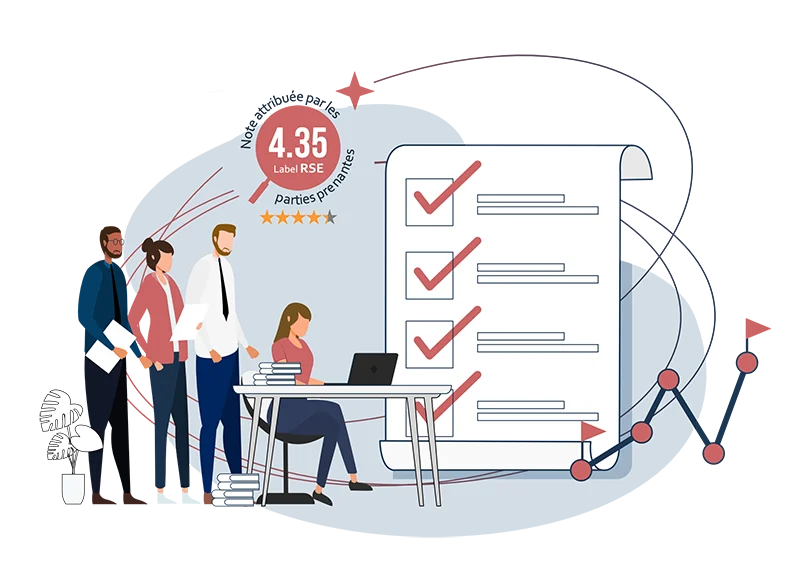
Measure the effectiveness of your existing CSR strategy
Have you already defined your CSR strategy? This offer helps you measure its effectiveness and decide where to focus next.
The audit combines fixed criteria, which determine your CSR label score, with customisable questions that let you evaluate your own priorities and explore issues across your value chain. Your stakeholders rate the core criteria of the Rate A Company framework; you manage the additional questions, which are excluded from the label score but can feed your double materiality assessment. Stakeholders can provide anonymous feedback through our independent platform.
Contact us
CSR AUDIT & STRATEGY PROGRAMME +
Build a practical CSR strategy and put it into action
Contact us
* Prices exclude VAT and apply to organisations with fewer than 500 stakeholders. Tiered surcharges apply to organisations with more than 500 stakeholders.