
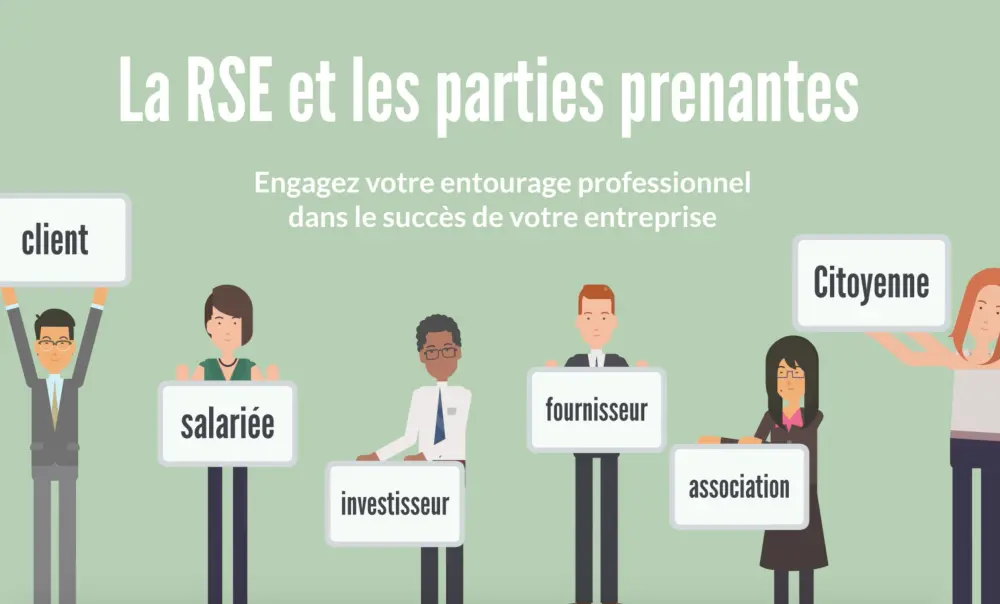
Many economic studies from the English-speaking world stress the importance of engaging stakeholders in a company's CSR strategy. Stakeholders are defined as "any group or individual who is affected by, or has an interest in, the company's activities and who can directly influence an organisation's objectives". A stake is an interest in something; the holders are those who carry or own it.
1. Understanding who an organisation's stakeholders are
The definition tells us that those directly affected by the company are: investors, employees and customers, but also suppliers and subcontractors. Yet others feel concerned by the company's activities for moral reasons: associations, NGOs, the media, trade unions, and also local communities.
For most modern economists in the English-speaking world, engaging stakeholders in the strategy is a sine qua non for a company's success. The idea emerged in the 1980s with R. Edward Freeman's book Strategic Management: A Stakeholder Approach. His theory counterbalances the approach of Milton Friedman, founder of modern capitalism and ultra-liberalism, which starts from the premise that "the company should only care about its shareholders" and that the State should intervene as little as possible in the economy.
Freeman starts from the principle that the archaic model where the entrepreneur uses what is around them, transforms it and sells it on their doorstep is outdated. Today, even a small company operates in a global environment, interconnected through the internet and social media. He notes that managers face far more constraints than before. Faced with a constantly changing world and growing competition, a boss or manager has to anticipate cultural, legal, economic, social and environmental changes. Yet one person alone can no longer master all of these aspects.
We will set out the main theories around stakeholders, and then finish with a simplified illustration of the major economic advantages of this approach.
2. Understanding the role of stakeholders in a company's reputation
The first thing when talking about stakeholders is to recognise their influence on the company's reputation.
A detailed Harvard Business Review article called Reputation and Its Risks, by Robert G. Eccles, Scott C. Newquist and Roland Schatz, perfectly sums up the value of this approach. The article explains that executives know how important their company's reputation is. Companies with a very good reputation attract the best candidates. They are seen as generating more value, which allows them to raise their prices. Their customers and partners are loyal and buy broader ranges of products and services. They also enjoy a higher stock market valuation. Moreover, in an economy where 70 to 80% of market value comes from intangible factors such as brand image, intellectual capital and goodwill, organisations are particularly vulnerable to anything that can damage their reputation.
For this reference media in the English-speaking business world, most bosses fail at reputation management. They only react in times of crisis and never put in place any management of reputational risk.
Managing reputational risk properly means accepting that reputation is a matter of perception. A company's reputation is the product of how its stakeholders perceive it: investors, customers, suppliers, employees, regulators, political figures, NGOs and local communities, on specific criteria such as product quality, good governance, employee/employer relations, customer service, intellectual capital, economic performance, and the handling of environmental and societal issues. A strong, positive reputation among stakeholders across many criteria will generate a solid overall reputation for the company.
The Harvard Business Review goes further and explains that if many organisations are unable to follow the advice and expectations of their stakeholders, it is because they have not planned to do so in the way they operate.
In an ideal world, investor relations would be handled by the CFO or CEO, customers would be surveyed through marketing polls, human resources would question employees, the communications department would manage the media, the CSR department would deal with NGOs and associations, and the legal department would monitor developments in laws and regulations. All held together by the leader's coordination and values.
The first problem is that most of the time, these departments do not talk to each other. Second, a survey revealed that 84% of the 269 managers questioned on this issue (Economist Intelligence Unit survey) believe that managing the company's reputation is down to the CEO alone. And so we come back to Freeman's premise: a boss can no longer single-handedly manage all these constantly evolving economic paradigms.
For a company, failing to engage regularly with its stakeholders is therefore a handicap for its reputation. This is all the more obvious when you consider that the most effective form of marketing today is word of mouth, or feedback from experience. And those who talk about you the most are those who know you best. One more reason to take care of the professional circle that should be your first ambassadors.
For Ford, the commercial role of stakeholders was obvious: his employees and their families were his first consumers. One wonders how this appreciation of the people around the company has deteriorated so much in recent decades.
Managing a brand's reputation and performance through its stakeholders is widely recognised by business specialists. Indeed, Interbrand, one of the world leaders in marketing management, publishes an annual ranking of the best brands. They constantly redefine the criteria used to judge the quality of a name, but the ones that endure are: the clarity of the company's mission and values, the commitment of stakeholders, the brand's responsiveness and authenticity from its creation to today, leadership in taking a stand and standing out from the competition, and the ability to engage stakeholders in its vision.
ISO 26000, the reference standard for CSR, also takes into account a company's consideration for its stakeholders.
3. Engaging your stakeholders in your performance objectives
Once the stakeholders and their influence on the company's activities have been identified, the company must organise its stakeholder management plan.
The aim is to prepare a communication and action plan to engage them, in a personalised way. You will not engage your customers in the same way as your employees, your suppliers, your partners, or local communities and associations.
One of the main academic authors on this principle is Max Clarkson. Between 1993 and 1998, 7 major principles of stakeholder management were identified to enable a company to commit to a real CSR approach:
1. Top management must know and closely monitor the issues that concern stakeholders and incorporate them directly into its decision-making and development strategy.
2. Top management should actively listen to the concerns of each stakeholder and communicate openly with them about the issues that concern them and their contributions to the company's success.
3. Top management must adopt ways of acting and behaving that respect the opinions and capabilities of each stakeholder.
4. Top management must recognise the interdependence between the efforts needed for the company to run well and the wealth produced; it must strive for a better distribution of wealth and take into account the constraints of the various stakeholders by assessing risks and weaknesses.
5. Top management must work in close cooperation with other entities, public or private, to prevent risks and dangers. If a risk cannot be avoided, those harmed must be properly compensated.
6. In general, top management must avoid activities that call into question inalienable human rights.
7. Top management must be aware of the potential conflicts between a) its role as business manager and b) its legal and moral duty towards its stakeholders and their interests. It must address these conflicts through communication, reporting or a compensation system which, if necessary, can be provided by a neutral third party.
Finally, the Centre for Innovation in Management has summed up the benefits of engaging stakeholders in 3 points:
#1 It boosts innovation and therefore competitive advantage: by engaging stakeholders, organisations can identify new business opportunities, since monitoring of new technologies, processes and trends is greatly improved.
#2 It contributes to a company's "Social Capital": social capital represents the networks and interactions between people who live and work in a shared society and help one another to obtain information, benefits or resources.
#3 Risk management: at a time when images can travel around the world in minutes and destroy a reputation, stakeholder engagement makes it possible to anticipate real risks (failure) and reputational risks.
4. An example of engaging stakeholders in a CSR strategy
Is the idea of engaging stakeholders not obvious? Let us try to simplify the literature with an illustrated example of stakeholder engagement.
Imagine that until now you were paid to score great goals: that is your job in the village. You have an old ball, you clean the stands every morning and you shoot. Suddenly, your village opens up and other players arrive from elsewhere. They too want to score goals to earn a living. Some have far more sophisticated balls, others have dazzling kits. Others, finally, take the council employee out to dinner to get the best time slots... The village's money has not increased, but competition is fierce. The players, now more numerous, shoot all day long, take risks and damage the pitch. The comings and goings in the stands cause accidents. Nobody knows who is shooting any more, the show deteriorates and ruins the turf, the noise wears down the neighbours. The strikers come to blows because they are treading on each other's toes. Part of your audience loses interest in the sport because they do not like these values. Your sector is gaining interest, but you know it will not last long.
Now, faced with this situation, you have a choice. You can always decide to:
- Pay the council employee hefty bribes to ban the other players (corruption);
- Secretly puncture the other players' balls and boots (a criminal offence);
- Keep playing despite the changed environment; perhaps part of your old audience will stay loyal regardless, hoping that in 6 months the pitch will still be in good enough condition for you to carry on;
- Shoot as hard as you can and keep shooting until you drop, to become the top scorer and earn as much money as possible, as fast as possible, before changing careers.
Freeman's idea of engaging stakeholders in your success could broadly be summed up by this approach: when you see the other players arriving, you go and see Roger, who works at the village bar, to strike a deal that suits you both. He will serve your customers: he knows the villagers well, he will quickly find out what they want to consume and build a connection. Next, you go and see Sabine, who knows health and safety well; she will suggest reorganising the walkways in the stands and smoothing the flow of people to prevent accidents. While she is at it, she will put out bins and deal with the litter problem. Paul is the village saddler. You go and see him because, having played ball for so long, you have an idea of what would work. You talk to Paul about designing a high-performance, 100% local ball.
Of course, you will invest time and money. You take the risk that your competitors will redouble their efforts to score goals in the meantime. And that they will copy what you do. But Roger, Sabine and Paul talk about you. Out of curiosity, the people around them come to watch you play. You look after the pitch, you treat their friends well, and because they work with you, they like what you offer. Roger, Sabine and Paul are loyal to you and pass on what the spectators and the other neighbours expect. You can constantly improve your offer and contribute to society. You now offer a complete experience and you act responsibly for the community.
Faced with this enthusiasm for goal-scoring, the media scrutinise every move: a new news topic is born. They try to dig up a fault. Since everyone likes you, earns a good living thanks to you, and you are always available and transparent in your interviews, they speak well of you and give you even more visibility. Your media exposure makes you a representative of the sector. Because you have this vision of the common interest and you play as a team, you try to find a solution so that the new players can also earn a living without endangering your activity. So you suggest they play ball with you: you have just invented football.
In Freeman's vision, there is therefore a philosophical approach and a notion of lasting shared benefit inherent in CSR. For a model to be exported internationally and to last, every stakeholder has to benefit from the company's development, and the company has to consult its stakeholders regularly on its strategic choices.

December 2, 2022 , 3:10 PM
Puisqu'on a supprimé mon commentaire, j'en remets un. J'ai beaucoup appris merci !