
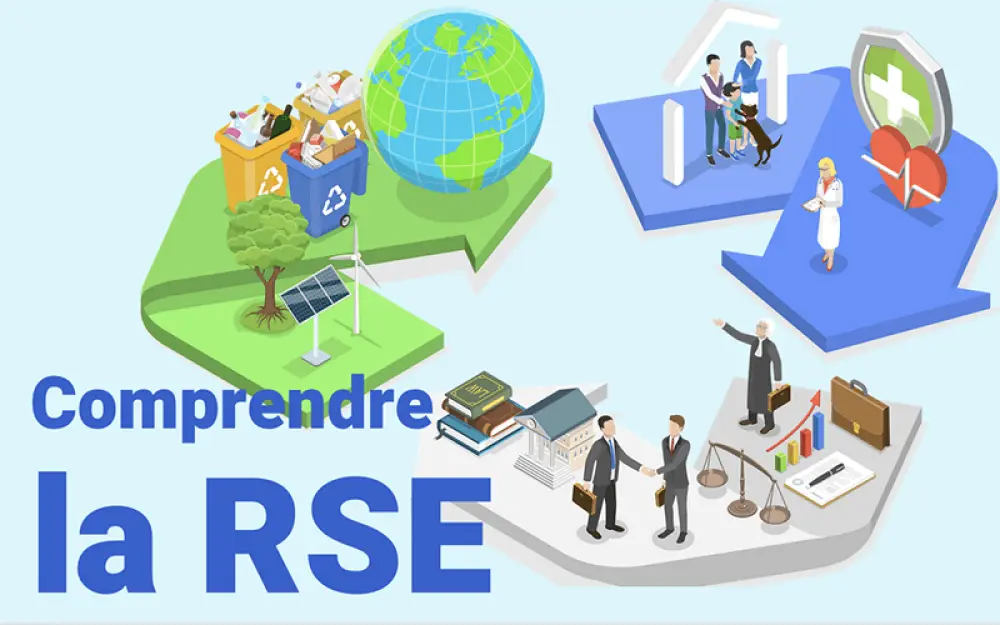
Even though most people don’t know the meaning, the term CSR is becoming more and more popular. Despite its recent popularity, the concept of CSR - or Corporate Social Responsibility, which encourages an organization’s best social and environmental practices - has been carried out for quite some time now, and it is a concept that seems crucial to ensure our world’s sustainability.
The Industrial Era encourages people to become responsible
You may wonder how this notion manages to progress in France, while it remains so obscure to most French managers. The concept of identifying and implementing best practices in a work environment comes from across the Atlantic Ocean, and emerged in the US during colonization. The absence of a legal framework and the subsequent abuses of people and property encouraged the pilgrims to quickly adopt new sets of business rules based on Christian values: respect the land you farm, and the people you work with.
However, it was only in 1953 that Howard Bowen, an American economist, theorized the concept and wrote Social Responsibilities of the Businessman. The theory soon took the name “Corporate Social Responsibility”, and was defined as a type of self-regulation for international private businesses, based on moral principles.
Carroll later elaborated on the topic, and organized the concept under a pyramid structure during the end of the 70’s. The pyramid, built around 4 responsibilities, is intended to ensure business sustainability. The responsibilities are ranked by order of importance from base to top:
- The economic responsibilities; a business must be profitable
- The legal responsibilities; the company must obey the law
- The ethical responsibilities; a company must respect the others and the environment
- The philanthropic responsibilities: I must share part of my profits with more unfortunate others
The implementation of these guidelines quickly enabled American companies to yield several positive outcomes. Firstly, if we consider the economic criterion, it is obvious that if I am profitable and pay my employees a decent salary, they will be loyal to the company. As a result, the company would benefit from increased productivity, and an improved corporate image from employees more likely to promote it publicly. Additionally, well-paid employees are more capable of supporting the local economy, which includes businesses that are my potential customers: “A rising tide floats all boats.”
Secondly, the American economic boom in the 50’s inspired legal and ethical reforms. While industrialization and consumerism kicked in, communities surrounding industrial areas began voicing their decreasing quality of life. Mismanaged production sites spoiled the natural resources surrounding them, and their employees rightly held their employers responsible. Devastated lands not only resulted in dampened moods, but also depleted the natural resources used in the goods the industry produced; therefore increasing their cost of doing business.
Last but not least, the notion of philanthropy led to the value of marketing and business reputation. The employee will further commit to the company’s success if he believes he’s working for a good cause. In return, the client likes to think that when he purchases from a responsible company, he also appears to be generous. As the company’s values reflect positively on its employees and clients, they also grant the business loyalty and blind trust.
CSR becomes essential to avoid future troubles
Today, the CSR principles influence the development strategy of most multinationals. Ikea is a probing example: with colossal timber requirements to supply their 411 stores worldwide, the Swedish company is the undisputed, world’s largest purchaser of wood products, representing 1% of the global wood market.
While deforestation takes its toll on the oh-so needed rainforests, IKEA takes a stand. The company recently decided to solely purchase from FSC wood suppliers by 2020. The Forest Stewardship Council (FSC) certifies that the trees are coming from responsibly managed sites, and works to prevent deforestation. The FSC certification is a step in the right direction to ensure that local communities, buyers, workers and the wildlife alike no longer suffer the consequences of remorseless producers. For Ikea, this approach means that the company protects its image during times of public outcry against global-warming. It also allows the furniture company to keep a high production pace without risking a natural resources shortage. Wood coming from managed forests facilitates the production chain: it guarantees that the same wood species will be used for a specific design sold in all stores worldwide, which improves product consistency. This strategic choice has forced many wood producers to quickly comply with the FSC requirements in order to qualify to supply the Swedish giant.
Wallmart, an American multinational retail company, is another example of smart CSR initiatives. Responsible for 11,718 outlets in 27 countries, the N°1 brand on the 500 biggest companies list has launched a green energy program. Solar panels have been installed on the roof of several stores, averting power outages and contributing to a greener world as our electricity needs are escalating. Most importantly, the solar panels allow the company to save up to 231 million dollars on their energy bill each year.
CSR ignites new business opportunities
CSR’s becomes crucial as competition is growing fiercer, and since young consumers tend to seek values as much as value in their purchasing habits. One brand particularly understood the opportunity emerging from this change of mindset: TOMS. From the start, their business model involved offering a pair of shoes to a person in need for every pair of shoes purchased. Backed with a strong marketing campaign, their shoes became a popular brand right from the start. Wearing TOMS shoes was no longer just about comfort and design, it was a form of activism claiming to support third world countries. TOMS’ stand won over the new generations, regardless of the fact that the shoes were overpriced, to meet their philanthropic goals with the duty to make profits. This kind of business model could actually grant additional advantages other than just overnight success: it provides tax benefits for donation as well as sorting another expensive problem; the handling of unsold items. Traditional business models now evolve to match the expectations of the Y and Millennial generations: eager world travellers, college educated, and very much determined to curb the growth of blind consumerism.
Another example for win-win strategy can be found in Dan Price’s strategy when rethinking his Californian company Gravity Payments. Bearing one of his employee’s bitter remarks concerning his very low salary in spite of his qualifications and hours spent in the office, Dan Price finds himself concerned. After some research, in 2015 he decides to pay his 120 employees a minimum wage of 70,000USD per year (against an average of 48,000USD before); an income that guarantees a comfortable lifestyle in the United State. To finance his vision, he had to cut back his million-dollar salary, leaving other CEOs skeptical. His strategy paid off as the large majority of his employees redoubled their efforts so much so that the year after, the company’s revenue and profits doubled as well.
If other American businessmen showed some criticism about his drastic choice, then they also are waiting for the mid to long-term results to see if it finally pays off.
Many General Electric, American Electronic Power, ExxonMobil, BP - just to name a few – need the most reputational support to meet their shareholders’ expectations. forward thinking executives are investing more time and organizational focus on genuine CSR initiatives, benefiting their communities and their own bottom. Unfortunately, some unscrupulous companies have found ways to hijack the concept. Instead of contributing significantly to the society and environment, they have decided to massively greenwash their image, while changing very little about how their business operates. According to the Cambridge Dictionary Greenwash is “an attempt to make people believe that your company is doing more to protect the environment than it really is”. In the United States, the biggest winners in this category, unsurprisingly, belong to the energy sector. According to an article published in the Huffington Post
You have to spend money to make money. Could investing in social initiatives, environmental business principles and green equipment solve our economic crisis and prevent global warming? In our article Circular economy turns metal into gold, creating new job opportunities; we have developed some of the keys for businesses to save or earn money and go green, not only on paper.
Did you know? The concept of CSR was first developed in the United States under French and British colonization, hence the reason why the US and UK host the most CSR compliant businesses according to the ratings methodology of CSR Hub.
USA : 6979 companies
UK : 1185 companies
Japan : 966 companies
China : 880 companies
Canada : 665 companies
South Korea : 484 companies
France : 429 companies
Germany : 338 companies
Did you know? Each year, Forbes Magazine publishes the list of global companies having the best CSR reputation. Once again, American companies account for the majority of them.
USA : Google, Microsoft, Disney, Intel, Cisco, Colgate-Palmolive
Germany : BMW, Bosch
UK : Roll Royce
Denmark : Lego (the actual winner of this ranking with 74.4 points).
Did you know? In 2010, 99 countries have voted the certification ISO 26000 that defines the principles of CSR and encourages sustainable development. Despite what was said before, the countries that voted against the certification text were: Cuba, India, Turkey, Luxembourg.. And the United States! The text has identified 7 core principles that an organization should implement in order to apply for the certification
- Organizational governance
- Human rights
- Labor practices
- Environment
- Fair operating practices
- Consumer issues
- Community involvement and development

October 17, 2022 , 12:44 PM
Article très intéressant