In CSR, there are 3 pillars a company can build on: the environment, social matters and responsible economics. CSR also stands for strong values such as good governance, labour relations and working conditions, fair business practices, support for local communities... So when we talk about sustainable development, it is not only about the planet: it concerns us directly too.
French micro-businesses and SMEs account for 99% of registered companies and create a third of the country's wealth. More importantly, together with mid-sized companies, they account for 72% of French jobs! So imagine what a more ethical approach to business would mean for the way we live. Just like the digital shift in the 1990s, companies have every interest in adopting ethical principles as early as possible, because tomorrow, commitment will be the norm.
Regulation requires companies above a certain size to innovate in CSR and find solutions, particularly for the environment (see our article on the CSR regulatory framework). With the 2019 PACTE Act, ALL companies must now "take environmental and social issues into consideration" in their activities. New legal statuses are also emerging to provide a legal framework for these new societal expectations.
As these efforts become ever more necessary, companies of every size will be subject to more demanding regulation regarding their contribution to protecting the environment and to people's wellbeing. Alongside regulation, new consumers are already pushing leaders to adopt this approach. Click here for our article on marketing and CSR.
The good news is that we give you some leads to start making changes today, so read the article to the end to find out how to make the most of these efforts in terms of impact.
As the head of a micro-business or SME, how can I set up a CSR approach?
The first thing a boss who wants to be more committed needs to know is that people are the main source of pollution. Yet according to the Ekodev CSR Barometer across all sectors, only 15% of people are involved in their company's CSR strategy, while 70% would like to be more involved. 33% say they would like to receive training on the subject. First-aid training is compulsory in companies, so do not hesitate to train staff in the right reflexes!
Micro-businesses, SMEs, mid-sized companies: some ideas to improve your environmental impact
Since the subject is all over the media, let us start with a few tips to limit your environmental impact:
-
Use less energy: if you have not already done so, switch to LED bulbs. Choose light colours for the walls to reflect natural light for longer.
-
Get rid of as many single-use consumables as possible: no more disposable cups, plastic bottles or coffee pods. The trend is towards reusable branded mugs, stylish sparkling or still water fountains, filter or bean-to-cup coffee machines, tea infusers and bulk groceries; in short, the authentic. Your image and the planet will thank you.
-
If you have not already done so, set up recycling bins and partnerships for the collection and treatment of ALL waste, including batteries, light bulbs, plastic caps and cigarette butts: young companies are managing to turn cigarette butts into furniture!
-
Outdoors, favour porous surfaces to absorb heat, and collect rainwater for watering and cleaning. Water can be saved by installing a dishwasher for staff (they come in all sizes).
-
Opt for more sustainable communication and marketing: it takes more intelligence and creativity, but if restaurants managed to put QR codes on their menus at the start of Covid, you will find solutions. From recycled corporate gifts or gifts sourced from craftspeople to point-of-sale displays in wood or recycled materials, look into it!
-
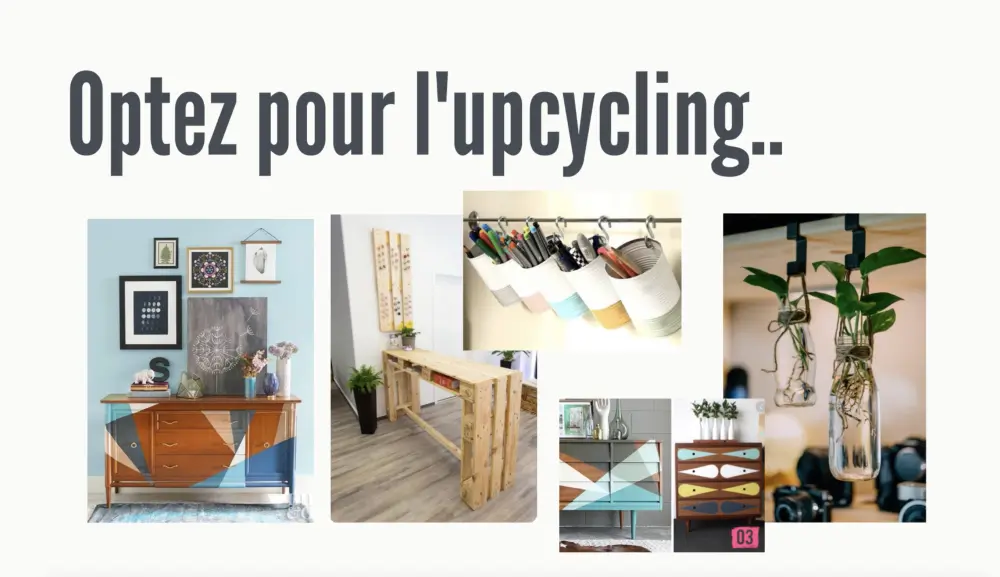
For furniture and equipment, remember to look first at recovery options such as upcycled or refurbished furniture! Bringing in an upcycling professional for a day can be an alternative to team-building, and give you 100% personalised offices that employees feel invested in.
Micro-businesses, SMEs, mid-sized companies: some ideas to improve the social side of your CSR
In this quest for a more ethical society, let us not overlook our own wellbeing. 82% of employees believe the company is responsible for their happiness
, according to an Ifop survey for the online media Philonomist.
Beyond the legal framework, social expectations depend on the activity and the culture within the organisation. Before taking drastic initiatives, it is important to consult your stakeholders, including employees, and to provide realistic and expected solutions rather than rushing headlong into a solution that you, as a manager or leader, happen to like. Our Rate A Company solution lets this information be raised on neutral ground, if needed.
Employees are not the only ones to consider in a CSR approach: you also need to think about your contribution to society: taking on young trainees without exploiting them, abolishing discrimination, and treating people with consideration and courtesy. For example, 9 out of 10 candidates say they get no reply after applying for a job: what image will they keep of your company once they are on the job market? Likewise, many sales representatives complain online about getting no answer to their quotes or proposals. For a good reputation, you can start by replying to all your stakeholders with courtesy.
Local communities: before funding an international NGO or offering to plant a tree on the other side of the world, find out about neighbourhood initiatives you could support, such as sports or educational associations: there are hundreds you could sponsor! You will gain goodwill locally, and it can lead to new partnerships or new opportunities. What is more, these efforts will be visible and verifiable far more easily than distant operations. According to the BVA survey on CSR, 78% of French people would like to see concrete evidence of brands' CSR commitment, and 64% of managers and professionals believe companies are not honest when they say they are committed to society and the environment.
CSR and economic principles
Probably the least known side of CSR, as the concept seems so abstract to many: how do ethics and economics go together these days? Nothing could be simpler.
Every year, Euler Hermes publishes an international league table of good and bad performers on payment terms: the shortest are found in New Zealand, at 47 days, the United States and Germany.
In France, they stand at 73 days. Internationally, this period has shortened by a day, while in France it has lengthened by 2! If you want to be seen as an ethical economic player, start by paying your invoices on time. According to the French Payment Terms Observatory, 40 SMEs close their doors every day because of this problem.
Next, to be a good economic player, treat everyone you do business with as if they were a friend: be transparent in your communication, your quotes and the way you operate. Even if you want to sign contracts, be clear about any weaknesses and do not use misleading advertising or messages. Moreover, just because your company is bigger does not mean you should treat other economic players with condescension or contempt.
Finally, one last principle to make you an ethical company: call on small businesses to innovate. Managers often turn to large groups for the prestige of the name, for lack of research or for fear of not seeing their request fulfilled. In the current economic context, many micro-businesses and SMEs like yours offer innovative, ingenious and original solutions. These companies very often offer more competitive prices, more flexible terms and more attentive service, so why not take the plunge?
How to make sure your CSR approach benefits your micro-business, SME or mid-sized company
Present your initiatives in your communication and on your social media. Be transparent on your website to encourage other parties to consider these solutions and to build a community around your values. Careful! We said present, not gush while seeking recognition or media and economic returns at all costs, especially if your initiatives cannot be quantified in terms of impact.
This communication is even more effective when it is not you doing the talking; hence the importance of cherishing your stakeholders and your reputation, including online!