Updated March 2024
The English-speaking and French definitions of marketing differ. Where the Anglo-Saxon approach is very pragmatic, the French definition is more conceptual. Marketing is therefore closely tied to culture. The Americans sum it up simply: marketing is the study and management of exchange relationships. Putting it into practice makes it possible to identify, anticipate, satisfy and create customer needs. Marketing is the art of persuasion.
1. How marketing has evolved through the ages
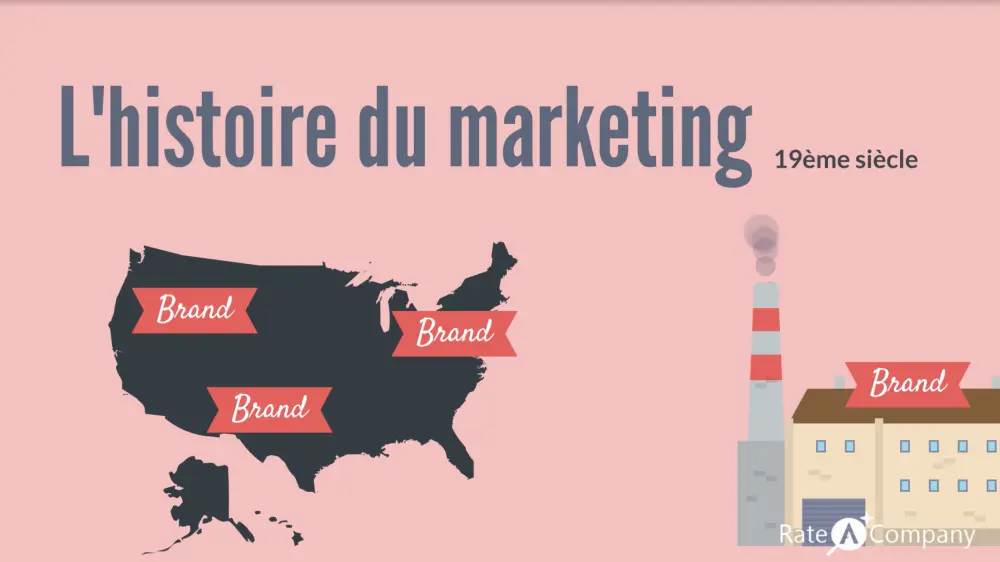
The term first appeared in 1897. Although the earliest adverts can be found on Roman amphorae, it was the development of transport, and then of communication media, that really grew this science. Large-scale industrialisation in the 19th century and the opportunity to distribute nationally pushed companies to build a standardised image and to identify supply and demand. However, as the Ford example shows, companies kept spending on their image to a minimum so they could invest as much as possible in production and guarantee a good product at the lowest cost. The best marketing at the time was therefore to offer the best value for money and to push that information to the right income bracket.
The Great Depression of 1930 made the approach more aggressive: information had to reach as many people as possible and discounts had to be promoted. Techniques such as door-to-door selling emerged.
From 1920 onwards, Nazi propaganda was deployed on a massive scale to bring the crowds into line. Radio, cinema, television, the press and posters spread Nazi hegemony, silenced opponents and had a huge influence on behaviour. These methods have been taken up again with social media and fake news to influence behaviour.
The post-war period and the Marshall Plan, which made the US loan for rebuilding Europe conditional on buying equipment and products made in the USA, allowed American industry to retool and reach new markets. That loan, which allowed the USA to impose its capitalist economic model on Europe, ushered in the golden age of marketing. Marketers used new tools such as television to make people "Buy, buy, buy", as William Young wrote in his book "The 1950s: American Popular Culture Through History".
According to an article in the American outlet Chron on the advertising revenue of television channels, it stood at $41 million in 1951. Two years later, with the new marketing approaches, it had already reached $336 million. It is easy to see why the series Mad Men is so fascinating. In the 1960s, competition was fierce and marketing acquired new tools, such as behavioural studies.
In the 1990s, the growth of the internet and of transport transformed the economy once again, making it global. With new markets to conquer, marketing became more forceful. With the internet, it became intrusive, and our personal data was collected to sell us more products. Overconsumption drove a throwaway culture, and the basic CSR principle of presenting a lasting relationship and a durable product was lost.
2. Marketing is evolving and adapting to CSR expectations
Philip Kotler defines the major eras of marketing as marketing 1.0, 2.0, 3.0 and, more recently, 4.0.
Marketing 1.0 dates from the 1950s and puts the product, its qualities and the offer front and centre. With the internet and growing competition came marketing 2.0, driven by the need to stand out. Praising the product was no longer enough: between two brands, the consumer chooses the company that will pamper them more. The customer became the centre of attention and brands began to offer unique experiences that stimulate the senses and encourage participation. Brands communicated a strong identity and values that shaped the profile of their customers. Once every company offered the same kind of customer service and had defined its identity, it had to stand out yet again in a context of ever more choice and booming consumption.
The era of marketing 3.0 began with the rise of mobile, geolocation and the collection of user data. Companies had to treat each customer as a unique individual, build loyalty with points programmes and an identity, and offer customisable solutions. For Kotler, this is also when expectations around ethics emerged: as offers multiplied and companies automated services and production with digital innovations, the economic gap between the richest and the poorest widened. Overconsumption was depleting natural resources, and this information started to be reported in the press. Consumers became aware of the limits of consumerism and started looking for ethical brands with strong values.
Philip Kotler goes even further on how important it is for companies to carry social and environmental values in his theory of Marketing 4.0. Tomorrow's consumers, now Generations Y and Z, have learned to question advertising messages. They use social media to voice their opinions and find out about products. They read online reviews and share their experiences in YouTube videos. These new consumers research products far more thoroughly and generally buy the offer that best matches their expectations: with online sales, competition no longer has borders. With falling recruitment and the opportunities of digital, entrepreneurs are multiplying. These young consumers, who grew up surrounded by advertising and with unlimited access to information, are challenging big corporations. With the environmental wave and social movements, these new generations want companies that are more engaged in society. 86% of French people expect companies to commit to society's challenges of their own accord.
Companies understand this, and greenwashing is emerging, denounced by the media and relayed by this interconnected generation. Some labels play along with complacency and encourage cynicism. The latest BVA survey on CSR (Corporate Social Responsibility, see our videos on YouTube) shows that 51% of French people believe companies are not sincere when they commit to society and the environment. 78% of respondents say concrete evidence of that commitment would help make companies more credible.
Trust is key in the eyes of consumers, and brands are redoubling their efforts to win it back.
3. Is artificial intelligence marketing compatible with CSR?
Artificial intelligence has many uses and saves content creators time.
However, a debate emerged in 2024 with the appearance of robot-generated influencers. Lil Miquela and Lu do Magalu are two examples, but more and more of them have millions of followers. Created entirely by algorithms, they are the product of the maximum number of teenage likes on personality traits, as shown in this ABC News report featuring the American company 1337, pronounced Leet. One more company in an AI market estimated at 125 billion dollars by 2035 according to the Gartner IT Symposium.
Nevertheless, content creators are sounding the alarm about these practices. First, because an influencer in theory keeps their freedom of thought. They can decide to stop associating their image with certain practices. That was the case of YouTuber EnjoyPhoenix, who announced in 2019 that she no longer wanted to promote a highly polluting cosmetics industry that charges its customers too much for marketing rather than active ingredients.
An influencer can also take breaks and warn about the dangers of always wanting more. After McFly and Carlito, it was influencer Squeezie's turn to take a break: a way of raising awareness about wellbeing and appreciating life's moments rather than possessions. For brands, the advantage of an AI influencer is the certainty of being able to make it say whatever they want, at any time, until the end of time.
As the ABC News report shows, influencers are urging brands to give up these virtual ambassadors: how could an AI recommend shampoo to its followers when it has no hair?
The other issue is CO2 emissions. Using AI turns out to be particularly polluting. According to experts, a single ChatGPT search can use up to 100 times more energy than a simple Google query. So what about these personalities that constantly have to scan millions of pieces of information to redefine themselves?
For interconnected consumers seeking transparency about initiatives, we created the Rate A Company platform, which lets you rate and comment on companies' environmental, social and economic efforts, so that companies can further develop good practices. Feel free to sign up and take part!