According to a BVA survey, 52% of French people suffer from a lack of recognition in their company.
The basic social principles of CSR
As we have seen in the principle of good governance (see our article on the subject), it is important to encourage the participation of every employee, and to change management attitudes where necessary: Employees must be able to do their work without hindrance, in the interests of the company and not in the interests of one of their hierarchical superiors. They must be encouraged and praised, especially if they show aptitude and proactivity in their work, and it's up to the manager to ensure that the laurels of their work are not awarded to someone else. This is the idea of horizontal management that is emerging among young workers. In a world where trends and technology evolve very quickly, technical knowledge is at odds with the field experience of their elders: executives are now often more highly qualified than their managers. To avoid frustrations on either side, horizontal management is emerging, particularly in the service and new technology sectors: orders no longer come in cascades, but decisions are taken by consultation between the various employees. This new mode of governance seems to be catching on.
According to an Ifop poll for Philonomist, 77% of employees would like to see more democracy in the workplace.
Improving opening hours and crèches
If you can't or won't implement home office, some solutions involve introducing more flexible working hours, or providing employees with facilities that can improve their daily lives, such as sports facilities or crèches. The government grants tax incentives to companies wishing to take this step: The incentive is equal to 50% of the amounts spent by the company over a fiscal year, up to a limit of €500,000 per year. Depending on your tax rate, membership of a company crèche can be deducted from taxable profits by between 15% and 33.3%, which can represent up to 83% of the expenditure subsidized by the state.
All you need to know about setting up a crèche in France HERE
All about the French legal framework and setting up crèches HERE
Similarly, since the circular of December 19, 2019, physical activity offered to employees in the workplace can no longer be considered a benefit in kind. In other words, a company that offers its employees access to a sports facility or physical activities with an instructor will no longer have to pay social security charges on these expenses, i.e. 54% of associated charges have now disappeared. Find more legal info
Secondly, as each person is different, we need to encourage flexibility and allow several options to meet employees' expectations. While the 90s tended to standardize jobs and turn employees into easily replaceable production agents, new expectations show that not all employees have the same lives, and that standardization can create dysfunction and dissatisfaction.
Finally, it's crucial to respect individuals when it comes to pay. Even if the manager thinks he's within his rights to pay the salary he intends, and takes precautions to ensure that the information is not known within his company, the business remains a small world: assume that everything is known, and that a bad practice can be costly in terms of reputation, as well as costing you a loyal employee.
Finally, customers and employees aren't the only people to consider. As a small or medium-sized business, you too can stand out from the big corporations and win the hearts of future customers, followers or brand ambassadors by taking the time to respond to solicitations in a personalized way. Just because the customer, student or salesperson isn't in a position of power doesn't mean you're entitled to ignore their existence.
Encourage Sponsoring skills
What does it mean? It's about making skilled employees available to smaller organizations that can't afford to pay an expert. Employees must be volunteers, and can be useful for a mission of general interest: associations can benefit from their presence, as reinforcements, for example.
The Admical association deplores the fact that only 2.7% of VSEs and 20% of SMEs declare their donations (compared with 81% of large companies, which remain the driving force behind the sector).
Declaring your corporate philanthropy when you're an SME
This voluntary sponsorship of skills enables employees to enhance their skills and discover other professional worlds, adding to their experience and well-being by making them feel useful. The time devoted to skills sponsorship is limited to 31% of the employee's time over the year.
The Social Solidarity Economy for SMEs
TheSocial and Solidarity Economy (SSE) refers to a group of companies organized as cooperatives, mutual societies, associations or foundations, whose internal operations and activities are based on a principle of solidarity andsocial utility.
These companies adopt democratic and participative management methods. They strictly control the use of the profits they make: individual profit is outlawed, and earnings are reinvested. Their financial resources are generally partly public.
Recruiting vulnerable or disabled people in SMEs
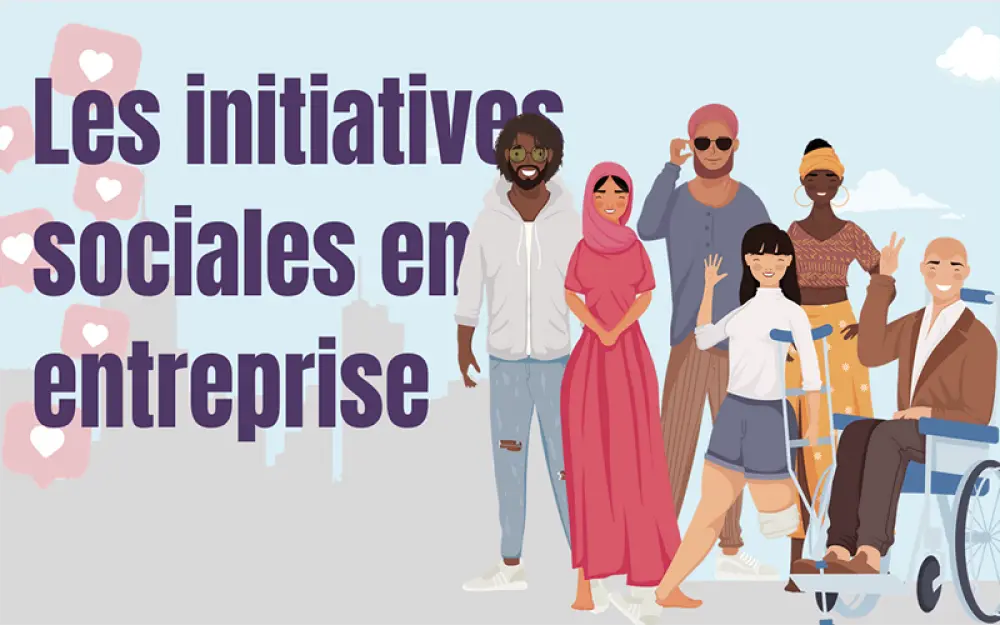
Another initiative is to recruit people in vulnerable situations, such as the handicapped or people undergoing reintegration. In this respect, the government has set up Geiqs throughout France. These Geiqs, specialized by sector, work with training organizations to help people isolated from the job market find new vocations, while providing solutions for sectors that are cruelly short of personnel. The Geiq acts as a guarantor for the employee, offering additional security to the company looking to recruit. This solution offers many advantages for the companies that use it. Contact your local DIRECCTE to find out how you can take advantage of this scheme.
In 1987, the French Disability Act made it compulsory for all companies with over 20 employees to employ 6% disabled people. However, many SMEs fail to meet this requirement, due to perceived constraints on office layout. However, Agefiph can provide an ergonomist to help with the fitting-out and draw up a cost estimate. In addition, companies with more than 20 employees can benefit from financial aid when hiring a disabled employee. This aid is granted only after the workstation of the new employee has been adapted, and after application has been made to Agefiph. Although this assistance is not always automatic, it can range from 5,582.50 to 11,114.25 euros for a renewable 3-year period. Agefiph offers many solutions to facilitate recruitment, so don't hesitate to contact them.
Assistance in hiring a disabled employee
Failure to comply with the 1987 Disability Act can be costly for a company:
- 20 to 199 employees = 400 times the SMIC hourly wage, i.e. 3904 euros
- 200 to 749 employees = 500 times the SMIC hourly wage, i.e. 4880 euros
- For companies with 750 or more employees = 600 times the SMIC hourly wage, i.e. 5856 euros.
This amount is multiplied by the number of disabled people needed to reach the mandatory 6% threshold.
The law allows companies to take on disabled young people from the age of 16, up to 2% of the mandatory 6% for companies with more than 20 employees.
To be considered responsible, a company must be sincere in its approach. Some SMEs and large companies take on large numbers of disabled trainees for a few weeks of observation training, in order to avoid the financial contribution they would normally have to pay to AGEFIPH for failing to recruit the expected quota.
As for the recruitment of young apprentices, the State has introduced exceptional measures linked to Covid-19. These grants are valid until February 28, 2021, and range from a maximum of 5,000 euros for an apprentice under the age of 18 to a maximum of 8,000 euros for an apprentice over the age of 18.
For a company that is sincere in its ethical approach, these efforts will help build a good reputation, particularly with investors and institutional partners. It will also give it the opportunity toattract the best candidates who are now moved by the atmosphere and ecological commitment of firms, as demonstrated by the "for an ecological awakening" movement.
Finally, it can also benefit from the happiness of its employees. According to a Harvard/MIT study, happy employees are 31% more productive, 2x less sick, 6x less absent and 9x more loyal...
On the other hand, limiting social issues to employees is reductive: for a company to be part of a sustainable development initiative, it needs to value ALL ITS STAKEHOLDERS with the same care: its customers (this has been a given for a long time, notably with the ISO 9001 standard), but also its suppliers and subcontractors - as recommended by the law on duty of care - but also sales representatives and candidates who can bring new solutions to the company. Finally, for an honest and transparent image, we must not neglect the press and associations, which are the guarantors of a company's good reputation.