Increasing demographics and their impact on consumerism is likely to exhaust our water resources. Desalinization is an option but the costs remain high and deter public and private decision-makers from investing. While technology tries catch up with water restrictions, this article highlights the current situation and the sources of improvement.
If most of us know that it is essential to save water and much public information has been conveyed that now bear fruits in terms of behaviors, we still have a long way to go until we finally treat this resource in a respectful fashion.
If we know well enough the ratio of blue vs. brown on a world map to assume that we don’t run out of the precious liquid, the first problem comes from the misunderstanding that most of the earth is covered by water. Being very few to actually drink salty coffee, we first have to differentiate seawater and freshwater. 97,2% of the water available on our beloved planet is seawater and 2,8% only is freshwater that can later be turned into drinkable water. Furthermore, 75% of the freshwater constitute the polar ice caps and if their melting means more water for us parched consumers, their melting also means the disappearance of our beloved idyllic islands. According to the French National Scientific Research Center, the ice caps melting would raise the sea level up to 67 meters (about 220 feet) above the current one. If we want to maintain our lands – and humanity – up to certain standards, we now have to consider that the share of potentially drinkable water is actually down to 0,7% of the global water volumes.
To understand why associations and institutions keep on warning us about the matter, we have listed the reasons to save water so you can contribute to a better world thanks to this flow of knowledge.
1. Water treatment is expensive and might threaten our health
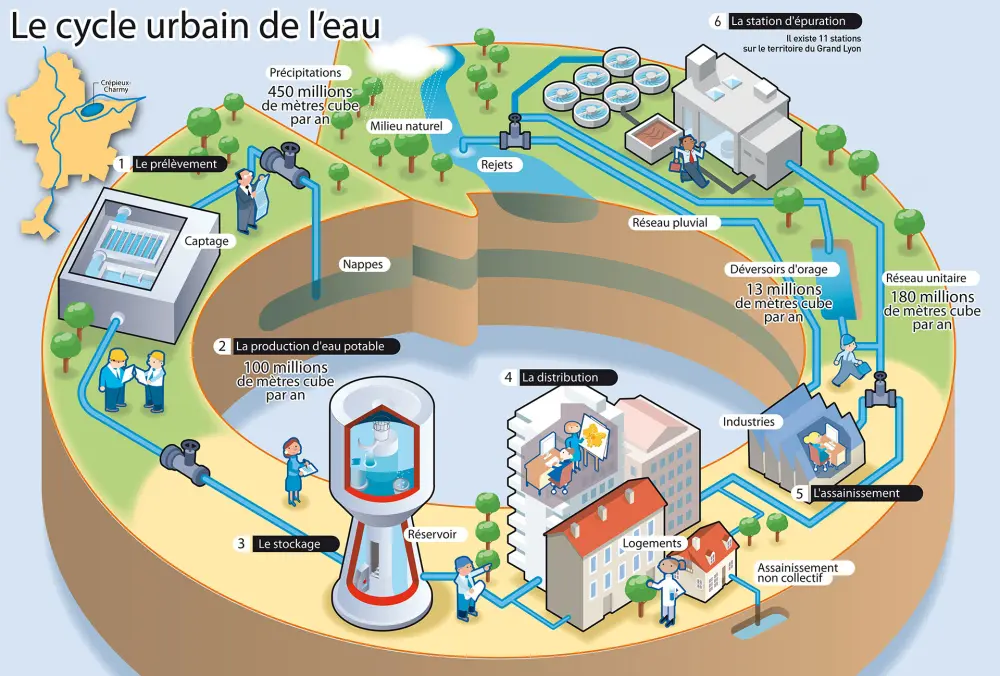
To understand the risks and their financial repercussions, we first need to understand the different steps of water treatment. When we wash our dishes, wash our hair and use the toilet, remains of food, chemical products and human waste but also solid waste like sanitary products end up in the pipes. Our water is also polluted by industries and agricultures. To get rid of any toxic substance and be drinkable again, the water has to be filtered several times until the smallest particles are eliminated. The process can vary from one treatment plant to another but overall, the several filtering steps will generate costs in equipment, maintenance, energy and chemical products like Ozone, coal and chlorine used to purify the water. In order to avoid any sanitation scandal, the best procedures must be respected.
Thousands are water treatment plants exist to supply thousands of hundreds of kilometers of pipes running under our grounds, risking clogging and deterioration at any time causing constant maintenance. Yet, everything has a price; the price for depollution can become quite expensive in some regions and the more you throw waste in your water, the more you’ll have to pay for it at the end of the day.
The other downside of such water treatment is the exhaustion of minerals contained in spring water, which are essential for our wellbeing. The repeated use of chlorine and filtering process to disinfect the water impoverish our drinks. On top of that, the tiny bit of bleach dropped in the water to protect it through its long journey to our kitchen sink might cause cancer. Several studies have shown correlations between colorectal cancers and the intake of chlorinated water, even in small dosage.
Other solutions could be implemented that would be less irritating for our organism but they are today far too expensive to be adopted on a large scale. At the end of the day, the important thing to remember is that the more you disregard water, the more it has to be treated, impacting your wallet and potentially your health.
2. Our economic model is facing growing water needs as consumption rises
The 0,7% of freshwater available for all on our blue planet must answer today’s fast growing needs in terms of agriculture, households, electricity production and industries, globally. While water resources on earth remain the same, we are now far more numerous than we were about 60 years ago and our appetite for manufactured good seems limitless. Our grandparents would be right to lecture us: we would use 7 times more drinkable water than they used to. Today, the industry represents about 20% of our total water needs while agriculture absorbs up to 70% of the world freshwater resources, in the hope of farmers taking it easy with pesticides and chemical fertilizers. However, these figures vary widely from a country to another. For instance, Sweden uses 61% of its freshwater for its industry purposes.
Belgium researchers have calculated that the quantity of freshwater available per person was down to 6,800m3 per person in 2004 when in 1970 it was almost twice this number (12 900 m3 pp). 14 years later, there are one more billion of us; the latest world population estimates announcing 7,7 billion people in 2018. Just to give you an idea, we were just above 2,5 billion humans in 1950 and we should be close to 9 billions in twenty years from now.
The other difference in between the 50’s and today, is that even a Papuan lost in the jungle claims a polyamide jersey and a smartphone and that 2,5 billions Chinese citizens will soon be culturally inclined to consume as much as an American.
3. We have to share a single planet and sharing water might be challenging
According to the World Health Organization (WHO) «Each person needs 20 to 50 liters of water free of harmful chemical and microbial contaminants each day for drinking and hygiene.»
However, for a single person only, washing your dishes requires 10 liters, flushing your toilet 5 liters, a brief shower 80 liters and your washing machine 50 liters. Add the water used for your food, your clothes and your energy production, grab your bottle of Evian, Aquafina or Fiji and calculate your grand total.
In developed countries, drinking water is available with no question asked. However, not all people enjoy such comfort. Only 71% of the world population has access to drinkable water at home. 11% of us do not have access to it, neither at home nor within 30 minutes walking distance from our place.
The countries where water is scarce are primarily located in Africa but not exclusively. Furthermore, in those regions, infrastructure and maintenance can be very expensive for taxpayers and/or end users. While globally, the gap is widening between the rich and the poor and that the United Nations announced that world hunger has risen for the third year in a row, why would some populations refrain themselves from crossing borders if this means ensuring their comfort, their hygiene, if not their survival?
In 1979, the term « Hydropolitics » appeared to define the geopolitical risks related to water access. Polluted waters, rerouted rivers, wasted sources are all the more reasons to start conflicts in regions where men fight for their right to farm their land or develop their industries.
A river can cross several countries. Having to share this vital resource represents a potential threat to the region’s stability, particularly when one nation decides to tap it for its development. This scenario has been a source of conflict in 1967 when Israel built an aqueduct on the freshwater Lake Kinneret while other countries like Lebanon and Syria felt duped, arguing that the lake’s water came from highlands on their territory. Another major example occurred more recently when Turkey announced its ambition to build 22 dams on the Euphrates and Tigris rivers, creating water predicament with Syria and Iraq. Hundreds of local conflicts have been identified in Africa or Latin America highlighting the risks at stake when water becomes scarce.
The real dilemma is: while water volume remains the same, how can a much bigger crowd split the cake in a peacefully manner? Several innovative industries and agribusinesses have successfully started to implement sustainable solutions: recycling rainwater or used water when possible, grow seasonal fruits, use better technology, optimize the processes, etc. For the end consumer, this water situation also means behaving accordingly: curbing wasting food and water, eating local and seasonal products, purchasing from responsible companies, reducing meat intakes… According to The Guardian, producing just 1kg of beef would require 15,400 liters of water while the magazine Science ABC highlights that this 1kg of beef generates the same amount of C02 than a European car driving for 250km.
If our aim is to truly live virtuously and leave a sound place for the future generations, it is up to us to change our consumer’s habits and encourage companies that have decided to go green and sustainable. Gone water does not mill anymore, says the proverb.
Did you know ? The quantity of fresh water used to produce energy globally will increase by 59% between 2014 and 2040. Several initiatives are implemented to reduce the cities’ energy consumption. For instance, the famous Butte-aux-Cailles Parisian swimming pool heats its pools thanks to adjacent start-up’s servers, relocated in the basement to serve the purpose. A similar principle has been implemented for the Aspirant Dunant Swimming pool, also in Paris, that uses the heat from sewage. They today manage to save the costs of half of its previous energy bill.
Did you know ? “The textile industry uses 4 billion tons of water a year to produce 30 billion kilos of fabric. According to the World Bank, it alone will account for 17-20% of the world’s water pollution. Consequently, manufacturers have to turn to new, more sustainable manufacturing processes, like the solution developed by the Dutch company DyeCoo. Adopted by Nike and Adidas, for example, the DyeCoo process dyes polyester without water, chemical additives or drying”
Did you know ? Global agriculture and food technology startups received a record $10.1 billion in investments in 2017, up 29 percent from 2016. These investments anticipate population growth and their subsequent food needs while resources remain limited. « Hunger has been on the rise over the past three years, returning to levels from a decade ago. This reversal in progress sends a clear warning that more must be done and urgently if the Sustainable Development Goal of Zero Hunger is to be achieved by 2030.” Informs the World Food Progamme (WFP) report in September 2018.