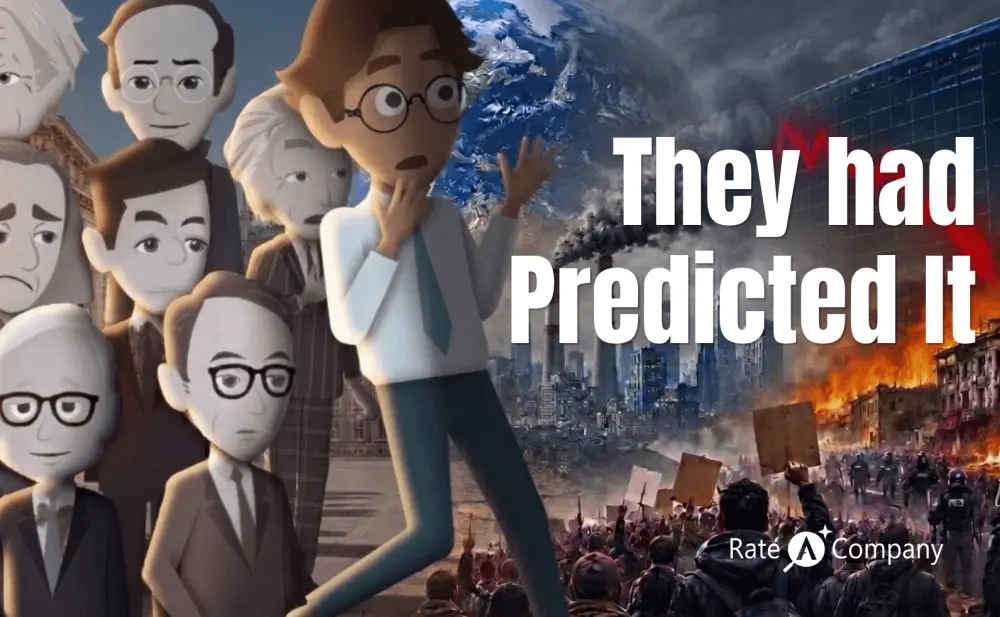
We were all shocked by the violence of youth protests and scenes of rioting in France. Images reminiscent of popular uprisings in Bangladesh, Kenya, Morocco and Madagascar.
And yet, in France, everyone is still talking about carbon footprints and environmental issues. How could we not, after a summer of scorching temperatures, with wildfires and floods devastating our regions?
In their public addresses in 2022, political leaders spoke of “unforeseen climate events” that could not have been anticipated.
Yet in 2024, Valencia received the equivalent of a year's rainfall in just eight hours. The toll: more than 220 deaths and €10 billion in damage. In January 2025, uncontrollable wildfires engulfed entire neighbourhoods in Los Angeles. During the summer of 2026, wildfires in France and Spain destroyed more than 373,400 hectares of forest.
Meanwhile, since 2022, the global economy has been generating record profits. In 2023, the Janus Henderson Global Dividend Index recorded an all-time high of more than $1.66 trillion in global dividend payments. A record broken again in 2024 and 2025.
France's CAC 40 companies have been riding this wave, returning nearly €100 billion to shareholders. At the same time, France is facing a major budget crisis, while spending €211 billion on business subsidies, primarily benefiting its largest companies, without assessing their positive impact on society.
Do you still think these events are accidents, unrelated coincidences?
The very first economists to define Corporate Social Responsibility (CSR), between the 1930s and the 1970s, warned us with surgical precision about what lay ahead.
Welcome to the forgotten and censored history of the prophets of economics, the pioneers of CSR.
ACT I — The Great “Social Costs” Scam
If there is one name you should remember, it is Karl William Kapp. Born into a wealthy German intellectual family, Kapp was able to study law and economics in Berlin. In 1933, he fled Nazism to pursue a doctorate in Switzerland before spending time at the prestigious London School of Economics. Like many intellectuals fleeing authoritarian regimes, he moved to the United States in 1937.
With such an impressive academic background for his time, Kapp was a particularly brilliant scholar. In 1950, this multilingual academic published his seminal work with Harvard University Press: The Social Costs of Private Enterprise.
The book sent shockwaves through the economic community of the time. It went on to achieve worldwide success, particularly in Japan.
Kapp raised a simple but devastating question: how do companies manage to generate ever-greater profits?
His answer was brutal: by stealing from society.
Kapp demonstrated that unregulated capitalism relies on a vicious mechanism: the privatisation of resources and the shifting of losses onto society. In short, to maximise its profits, a company must pass its bills on to citizens.
In 1950, Kapp argued that private enterprise operates in a manner incompatible with overall efficiency, shifting a substantial proportion of its production costs onto society, workers and future generations.
He drew on very specific examples:
- The toll on human health: if a factory destroys its workers' health through relentless production schedules or exposure to toxic substances, the company pockets the profits, while social security systems, families and the state pay for medical treatment.
- The plundering of nature: if a factory discharges toxic waste into a river, the water becomes unsafe to drink. The company saves money on waste treatment, but society must spend millions cleaning up the pollution. Tax revenues that could otherwise have been invested in education or research.
In Valencia in 2024, the floods were caused by Mediterranean Sea temperatures running 2 to 3°C above normal. The result: an atmospheric bomb.
Yet, oil companies have known since the 1970s that their activities have a significant impact on CO₂ emissions and the melting of ice.
So who paid for the billions in damage? Spanish taxpayers. Within the first few weeks, Pedro Sánchez's government presented two emergency relief packages totalling €16.6 billion, funded by Spain's 24 million taxpayers.
Meanwhile, some four million shareholders in the global oil industry benefited from a historic $272 billion in dividends and share buybacks.
The paradox of this logic is that, since the 1970s, human beings have been conditioned not to address this net loss and ticking time bomb, but instead to hope that they will one day be among those who manage to keep their heads above water.
Literally.
For reference, here is a breakdown of net profits in 2022, just after the environmental awakening brought about by the lockdowns:
- ExxonMobil (United States): $55.7 billion, an all-time company record and the highest profit ever recorded by a Western oil company.
- Shell (United Kingdom / Netherlands): $39.9 billion, the highest profit in the company's 115-year history.
- TotalEnergies (France): $36.2 billion in adjusted net income. Reported net income amounted to $20.5 billion after asset impairments associated with its withdrawal from Russia.
- Chevron (United States): $36.5 billion, twice its 2021 profit.
- BP (United Kingdom): $27.7 billion in underlying adjusted profit, its highest profit in 114 years.
Ultimately, we come back to Kapp's observation: conventional financial accounting is an illusion.
Financial statements do not measure the wealth created; they measure the extent of the costs a company imposes on society.
ACT II — When Economic Power Threatens Social Peace
While Kapp was developing his theory of environmental plunder, others were becoming increasingly concerned about the evolving structure of capitalism and its impact on democracy.
In 1932, two Americans, Adolf Berle and Gardiner Means, published The Modern Corporation and Private Property. They revealed a historic shift: the owners of corporations — their shareholders — were no longer running them. Professional managers had taken control. The larger the corporation, the greater its executives' influence over government decisions.
Yet nobody elected them, and they are not accountable to any citizen.
It was this notion of hidden power that prompted the business and economic communities to commission Howard Bowen's book, Social Responsibilities of the Businessman, published in 1953, which would become a landmark work in the field of CSR.
In 1953, Bowen issued a historic warning.
He argued that the several hundred largest businesses constituted vital centres of power and decision-making, and that their actions affected citizens' lives in countless ways.
“It is becoming increasingly obvious that a freedom of choice and delegation of power such as businessmen exercise would hardly be permitted to continue without assumption of social responsibility.”
“Indeed, all social organization — of which economic organization is but one aspect — requires that individual members of the group accept common values and goals, and guide their behavior accordingly. If they fail to do so to any significant extent, organized society ceases to exist, and chaos and anarchy prevail.”
This is what economist Karl Polanyi called the “double movement” in his 1944 book, The Great Transformation: the harder we try to impose a “pure and perfect” market by cutting public support, lowering wages and deregulating the economy, the more violent society's response becomes.
“To allow the market mechanism to be sole director of the fate of human beings and their natural environment […] would result in the demolition of society.”
“Such an institution could not exist for any length of time without annihilating the human and natural substance of society; it would have physically destroyed man and transformed his surroundings into a wilderness.”
ACT III — Earth Is a Spaceship
By the late 1960s, the warnings had taken on a physical and biological dimension.
In 1966, British economist Kenneth Boulding published a brilliant essay: The Economics of the Coming Spaceship Earth.
Born into a modest family, Boulding owed his place at Oxford to his intellectual abilities. He went on to become one of the leading figures in American economics and would be nominated several times for the Nobel Prize in Economics or the Nobel Peace Prize.
Boulding explained that we needed to move from a “cowboy economy” to a “spaceman economy”.
- The cowboy economy: we assume that resources are infinite, that we can consume without limits and dump our waste somewhere further out on the prairie.
- The spaceman economy: Earth is a closed spaceship. Everything is finite. There is nowhere outside it to dump our rubbish.
Then came the bombshell of 1972: the MIT Meadows Report, The Limits to Growth.
For the first time, researchers used supercomputers to model the global economy. Their conclusion was unequivocal: if industrial growth and resource extraction continued along their existing trajectory, the global system would collapse before the middle of the 21st century.
They did not predict the exact date of the 2025 Los Angeles wildfires, but their projected ecological overshoot curve bears a terrifying resemblance to the trajectory we are experiencing today.
ACT IV — Small Is Beautiful
What if the fundamental problem was not simply what companies do, but how large they become?
In his 1973 book, Small Is Beautiful, German-born British economist Ernst Friedrich Schumacher warned that multinational corporations that had become more powerful than states would inevitably wrest democratic power away from them.
In his view, for the economy to benefit citizens, we must:
- Favour businesses and production units operating on a human scale.
- Decentralise economic power and promote local economies.
- Develop technologies suited to human needs.
- Preserve natural resources rather than treating them as an inexhaustible form of capital.
- Make the economy serve humanity, rather than the other way around.
This economic principle echoes Germany's industrialisation in the 19th century. From the 1950s onwards, Ludwig Erhard, the father of the German economic miracle, embraced these principles through the Mittelstand: a network of independent, often family-owned businesses with strong roots in their local communities.
Germany therefore has more medium-sized businesses creating jobs, whereas France's business landscape is becoming polarised between micro-enterprises that are highly vulnerable to economic shocks and very large corporations.
Here are some indicators of the success of this alternative vision:
| Indicators | France | Germany |
| Population (2025) | 68.6 million | 83.6 million |
| Number of active businesses (2024) | 5.6 million | 3.2 million |
| Nominal GDP (2025) | €2.979 trillion | €4.470 trillion |
| GDP per capita (2025) | $48,986 | $60,496 |
| Public debt (% of GDP) | 115.6% | 63.5% |
| Public deficit (% of GDP) | 5.1% | 2.7% |
| Unemployment rate (2025) | 7.5% | 3.7% |
| Global Innovation Ranking (2026) | 13th | 11th |
Sources: Eurostat, Destatis, World Bank, WIPO – Global Innovation Index.
ACT V — The Sabotage: How Friedman Killed CSR
Boulding had a knack for striking phrases that exposed the blindness of some of the economists emerging from the Chicago School between the 1950s and the 1970s.
In 1973, he was quoted as saying:
“Anyone who believes exponential growth can go on forever in a finite world is either a madman or an economist.” — Kenneth E. Boulding
For the leading figure of the Chicago School, the father of neoliberalism, was none other than a particularly formidable economic adviser: Milton Friedman.
The vast majority of the most brilliant economists in Britain, Germany and the United States in the early 20th century had learnt the lessons of the economic history that had led to the Wall Street Crash of 1929 and the wars in Europe.
They advocated a fair distribution of wealth, the preservation of resources and a state independent of private interests, capable of governing with a commitment to progress and the common good.
It was under the influence of these economists that Keynesian economics developed, alongside the famous thirty-year post-war economic boom known in France as the Trente Glorieuses, which enabled our grandparents' generation to become homeowners while enjoying strong social rights.
But at the dawn of the 1970s, a movement began to take shape.
An increasingly prosperous population could no longer understand why wealthy Americans had been subjected to a 91% tax rate for twenty years to finance a war in Vietnam that cost nearly 10% of American GDP in 1968 ($111 billion in dollars of the time), killed or wounded more than 200,000 young people and ended in a sense of humiliation at the hands of a small communist country.
Discontent was mounting.
In September 1970, a man we have already discussed on this channel would capitalise on this social unrest to bring about a radical break with the past. A break that would, within a few decades, lead to the downfall of an entire system.
Standing just five feet tall and coming from a modest background, Milton Friedman had a score to settle with life.
Having become the standard-bearer of the Chicago School thanks to his oratory skills, this statistician used figures to manipulate with charm. He would remind us that man is, above all, a wolf to his fellow man.
“The Social Responsibility of Business Is to Increase Its Profits.”
In this article, published in the renowned New York Times Magazine, Friedman shattered an entire societal framework that had taken decades, if not centuries, to gain acceptance.
“The businessmen believe that they are defending free enterprise when they declaim that business is not concerned ‘merely’ with profit but also with promoting desirable ‘social’ ends; that business has a ‘social conscience’ and takes seriously its responsibilities for providing employment, eliminating discrimination, avoiding pollution and whatever else may be the catchwords of the contemporary crop of reformers. […]
Businessmen who talk this way are unwitting puppets of the intellectual forces that have been undermining the basis of a free society these past decades.”
As an economic adviser to President Richard Nixon and later Ronald Reagan, Friedman would, within a few years, sweep aside all the warnings issued by economists far more qualified than himself.
CONCLUSION — Rethinking Performance and Investing in Education
Today, when you hear about CSR, what you are often being sold is office recycling, carbon footprints offset by planting trees on the other side of the world, or green logos.
This is a betrayal of history.
The economists of the 1930s to the 1970s did not invent CSR as a marketing tool or as a means of producing reports that would help companies sell more. They conceived it as an emergency safeguard against climate collapse and civil wars.
They had warned us:
- That a company cannot remain viable in a collapsing society (Bowen).
- That profits derived from the destruction of nature are based on flawed accounting (Kapp).
- That a world with finite resources cannot sustain infinite growth (Boulding / Meadows).
Today, climate crises and social uprisings are no longer theories on paper.
They are here.
So, now that we have established all this, what do we do?
We go back to basics: we invest in people's ability to live together and in their skills, two imperatives according to Adam Smith.
To achieve this, governments must reintroduce traditional moral and civic education, as it was taught in French schools from the time of Jules Ferry in 1882 until 1975.
Secondly, we must invest in our own nation: in education, healthcare, innovation and domestic expertise.
And when we talk about education, we are not simply talking about engineering degrees. We are talking about a broad range of knowledge, the ability to think independently and critical thinking skills.
The state must also anticipate future challenges and plan for the long term, guided by a collective vision that fulfils the social contract: ensuring security and improving living conditions for everyone.
After all, what is the point of creating ever more wealth if the very society that produces it is falling apart?
We will not be able to say that we did not know.