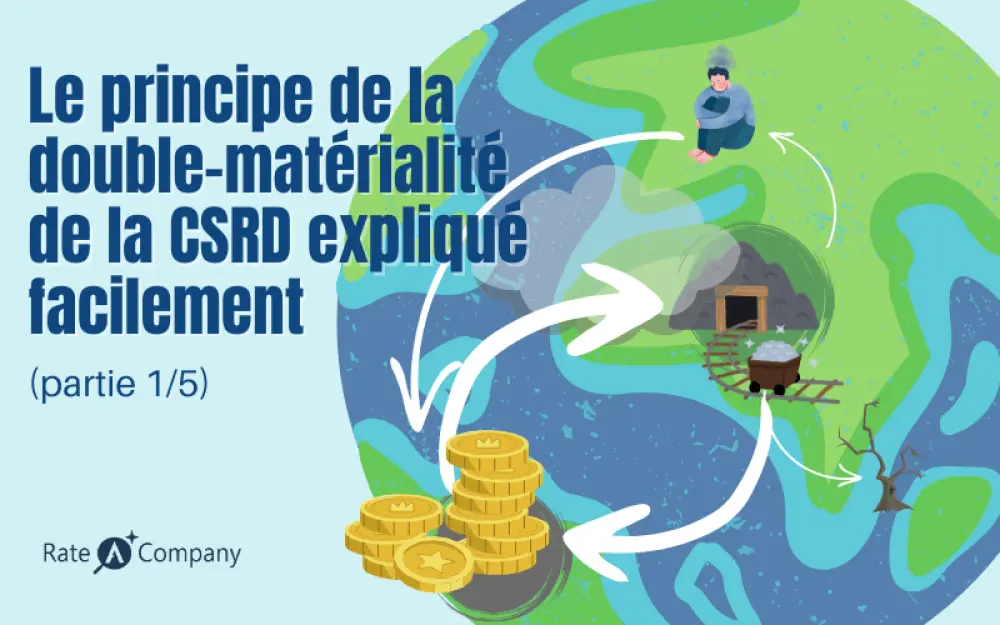
This article is the first in a series of 5 articles designed to provide an easy understanding of double materiality. By bringing together all EFRAG's sources and documents, we have simplified and illustrated the concepts to help you achieve a materiality analysis that not only prevent risks, but also identifies opportunities.
Financial materiality has been known for years: how do price changes of raw materials, labor, energy, etc. impact my sales and the dividends I'll be able to pay myself? How can I manage fluctuating costs when every time I increase them, I run the risk of losing my customers?
Consideration of external fluctuations is one of the elements to be taken into account in double-materiality. For some years now, phenomena have been killing century-old companies from the inside (see the Did you know at the end of this article). Greed for profit, contempt for universal moral values: these incidences “materialize” and have a concrete impact on the ability to generate profits, sometimes even leading to bankruptcy.
These contextual risks can take many forms: floods, social tensions, geopolitical crises affecting prices, sovereignty of sensitive data... A whole range of epiphenomena that might seem anecdotal therefore have real material consequences.
But we're going to try to understand how CSRD, based on the principles of CSR so popular 80 years ago in Anglo-Saxon business schools, is going to bring awarness on what is at stake and the necessary changes, thanks to its double materiality concept.
The CSRD already addresses the question: how much responsibility do companies bear for global equilibrium and instability ?
Secondly, if companies are responsible for our condition, can they contribute positively rather than negatively?
But first, to understand CSRD, we need to answer the following question:
What is the difference between “materiality” and “double materiality” in the CSRD?
None.
With CSRD, the notion of “double-materiality”, or the assessment of the consequences of our activities on our quality of life, is gradually becoming “materiality”.
As if, in 2023, we were discovering that we depend on our planet and its inhabitants in the paradigms of our global economy. A return to our roots. “Double-materiality” and ‘materiality’ are therefore used interchangeably in the CSRD.
The CSRD definition of double materiality
"Double materiality must take into account the company's impacts, risks and opportunities, real or potential, negative or positive, on the planet. Its consequences (materiality) must be measured in terms of their severity on people or the environment; the number of people who are or could be affected, the extent of the damage caused and the ease with which this damage could be repaired by restoring the environment or the people affected to their previous state."
A tool for measuring environmental impacts was introduced after the Kyoto Protocol in 1997. Since 2001, the GHG Protocol has coordinated a method for measuring carbon emissions or equivalents (other gases). This method inspired Ademe to register the famous “bilan carbone” trademark in 2004, designed to transform this international ecological impulse into a business opportunity in France.
Nevertheless, the CSRD opted for the internationally recognized GHG Protocol methodology. According to European experts, this methodology is just as effective as the French method, yet easier to understand.
This desire to monetize a global scientific collaboration at all costs could be an example of materiality: what were the revenues from this privatization compared with the costs of 20 years' delay on climate change?
Analysis of materiality helps to understand CSR in its entirety
With the CSRD, we realize that climate change is only one of the emergencies to be addressed. Plastics in the oceans, soil pollution, malaise in the workplace, epidemics, drug problems, impoverishment of Western populations... The model of a universal, prosperous middle class of the 1950s is no more. An observation that prompted some of the Americans to vote for “Make America Great Again” based on the wrong reasoning.
The new European regulation has opened the eyes of those who thought that carbon measurement alone was enough to declare a company “responsible”. In order to understand the systemic risks we face, the CSRD lists the paradigms to be addressed in its ESRS and sub-categories.
Our decisions have multiple implications: production methods, sales strategies, purchasing behavior, use and processing of raw materials, re-use and reparability of equipment, ethics and mutual aid in our behavior, values, and so on.
In an interconnected world, we are rapidly seeing the limits of Friedman's postulate. Indeed, in the 1970s, Friedman disempowered governments and unburdened businessmen by declaring that the sole purpose of a company is to maximize its revenues in order to increase shareholder dividends. The progressive equilibrium emerged after the 1930s, leading to the rise of the middle class, was overturned.
As Milton Friedman harangued the importance of disengagement in the 1970s, we can already see the consequences of this individualistic doctrine. Yet this award-winning economist was a resounding success for his simplistic method, echoing a generation affected by a certain context. In the 1960s-1970s, we are in the midst of the Cold War. The inhabitants of this planet believe they can stop it at any time with nuclear weapons. Economic dogmas were changing, including in politics and economic textbooks; consumption was needed at all costs, before it was too late. Every man for himself, help yourself, because tomorrow may not be. This is a materiality that is very simple to understand on sales.
Today, however, we realize that life goes on, and that this posture generates major risks. Risks that CSR theories had already anticipated in the early 20th century. After all, what led to the economic and cultural success of France in the 19th century and the United States in the 20th were progressive values. Access for all to the famous social elevator, whether "Parisian cocottes" or ambitious young entrepreneurs, the development of art within the working classes, the protection of workers, the right to vote and access to education for women, the protection of children and the generalization of schooling, access for workers to products hitherto reserved for the elite. The values of the superhero who sacrifices himself for others. These are the universal values that have driven the cultural success of France, Western Europe and the United States on the international stage.
Notions that have nourished the foundations of CSR, and which we hope to reinstill in an attempt to bring back a little common sense, sustainability and prosperity.
The principle of common sense is regularly taken up in CSRD. The company must be far-sighted in assessing the “IRO” of each activity. IRO stands for : IMPACT, RISKS, OPPORTUNITIES, and is a recurrent theme in CSRD documents.
Stakeholder involvement is decisive in materiality analysis. Double-materiality is therefore based on cause-consequence analysis in a particularly complex context. Stakeholder involvement not only enables causes and consequences to be measured more accurately, and scenarios which might previously have escaped management's notice to be envisaged, but also enables us to work with everyday behavior. An expertise that Rate A Company has particularly mastered since 2015.
To achieve double-materiality, the company needs to base itself on the IROs of each ESRS and their sub-categories. Don't panic, the methodology is detailed in the 3rd article. In short, if one of the pillars, or ESRS, is not considered material, i.e. as not affecting the company or the planet, it will not have to be dealt with in detail. Because of the urgency of dealing with climate change (remember: the urgency started in 1997), when it comes to ESRS E1 on CO2 emissions, the company must nevertheless justify why it considers that there is no materiality.
And yes, all organizations consume at least some electricity and require travel, at least to get to their place of work.
Did you know ?
Notions of materiality were inspired - among others - by the International Integrated Reporting Framework and the economic article How ESG Issues Become Financially Material to Corporations and Their Investors? written by 3 Americans, David Freiberg, Jean Rogers, George Serafeim in 2019. In their introduction, they note the lack of business ethics at Purdue Pharma, an American pharmaceutical giant for over a century, and the disastrous consequences that will follow. Aggressively marketing their flagship product “OxyContin” on 81 out of every 100 prescriptions, Purdue Pharma caused the overdose deaths of 400,000 Americans. The repercussions of this aggressive marketing policy cost the company $80 billion annually, not least in lawsuits. The company eventually filed for bankruptcy in 2023. This is just one example of the consequences of destructive greed.